
TL;DR: Qustodio doesn't actually filter YouTube. It just flips a switch on YouTube's own "Restricted Mode," which misses about 20-30% of bad content and is incredibly easy for kids to get around. If you're paying $137.95/year for Qustodio specifically to keep YouTube safe, you're essentially paying for a free feature that doesn't work very well. WhitelistVideo is a better bet because it lets you pick exactly which channels are allowed, blocking everything else by default.
The Qustodio YouTube Problem
You’re paying $137.95 a year for Qustodio Premium. You see "YouTube monitoring" on the feature list, turn on the filters, and figure your kids are safe. But there's a catch.
Here is the reality of how Qustodio handles YouTube:
It just toggles on YouTube's built-in Restricted Mode. That’s it. There is no proprietary filtering technology or special channel control. You are paying over a hundred dollars for something you could do yourself in the YouTube settings menu for free.
The bigger issue is that Restricted Mode is notoriously unreliable:
- It misses a lot: About 20-30% of inappropriate videos still get through.
- Kids bypass it in seconds: They just use incognito mode, a different browser, or log out of their account.
- It's frustratingly blunt: It often blocks educational videos while letting junk through.
- No customization: You can't tell it "allow this one specific channel." It's all or nothing.
Qustodio isn't necessarily a bad app, but they market YouTube safety as a solved problem when they're really just leaning on a broken, native filter.
Will WhitelistVideo Work for Your Child?
Answer 4 quick questions about your child's devices and age — get a personalized setup recommendation.
10,000+ families · FreeWhat Qustodio Actually Does (And Doesn't Do) for YouTube
What Qustodio DOES for YouTube:
- Enables Restricted Mode: It automates the free toggle in YouTube's settings.
- Forces SafeSearch: It tries to keep search results clean.
- Time limits: You can set a "hard stop" for how long they spend on the app.
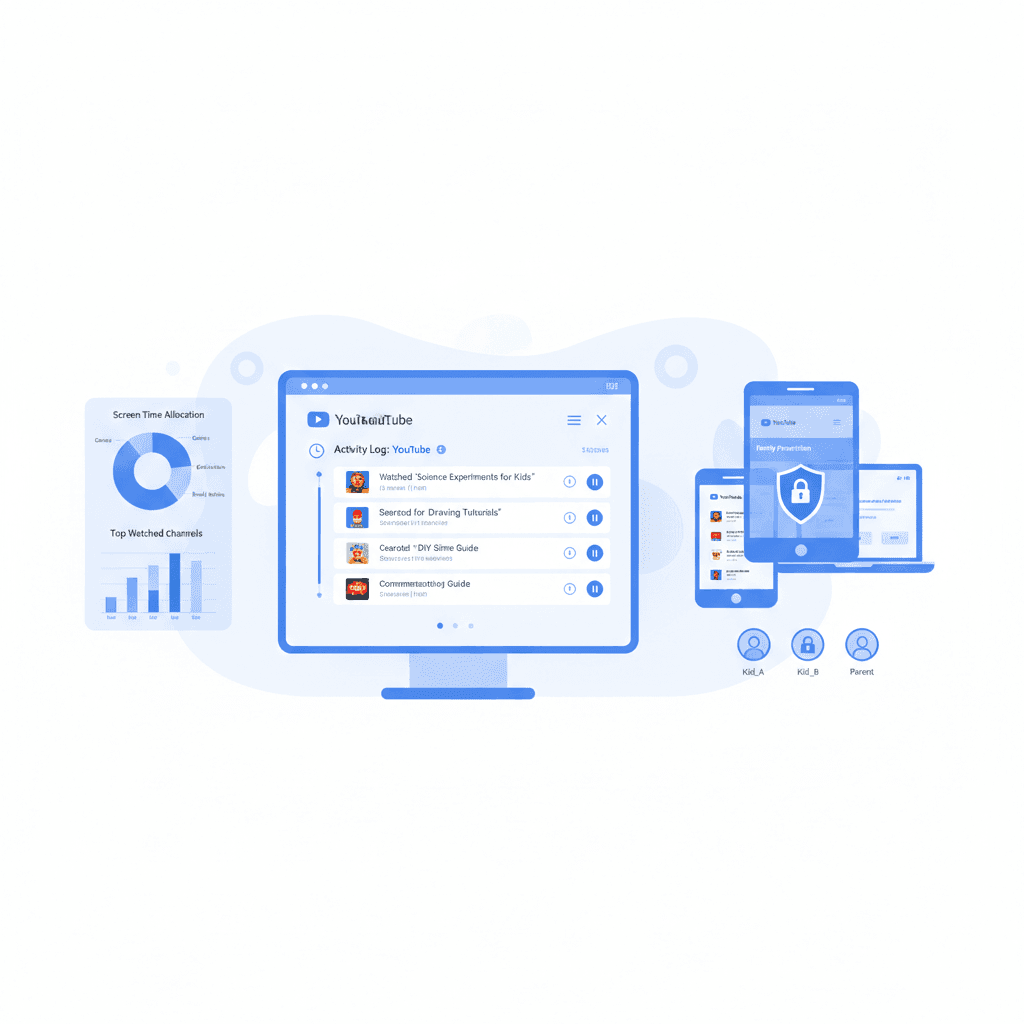
- Activity logging: It shows you a list of URLs they visited.
What Qustodio DOES NOT Do for YouTube:
- Channel whitelisting: You can't create a "safe list" of approved creators.
- Real-time analysis: It doesn't actually "watch" or scan the video content.
- Stop bypasses: It can't stop a kid from using a VPN or a private tab to see whatever they want.
- Granular blocking: You can't block a specific annoying influencer without blocking all of YouTube.
- Shorts protection: It has no specific way to handle the chaos of YouTube Shorts.
The Truth About Qustodio's "YouTube Monitoring":
Qustodio tells you what your child watched *after* they watched it. It’s reactive. If your kid spends an hour watching something they shouldn't, you'll get a report about it later, but the damage is done. For most parents, the goal is to prevent the viewing in the first place, not just document it.
Why YouTube Restricted Mode Fails (And Why Qustodio Can't Fix It)
Problem 1: Algorithms aren't parents
YouTube uses machine learning to flag "mature" content. It looks at titles, tags, and community reports. But algorithms are easily fooled. We've seen time and again that 20-30% of inappropriate content gets through, while a perfectly fine history documentary gets blocked because it mentions a war. Qustodio can't fix this because they are just using YouTube's math.
Problem 2: It's too easy to get around
If your child is over the age of eight, they probably already know how to bypass Qustodio's YouTube filter. They can:
- Use Incognito mode: This starts a session where Restricted Mode isn't active.
- Switch browsers: If you lock down Chrome, they just open Firefox or Safari.
- Log out: Restricted Mode is often tied to the Google account. No account, no filter.
- Use a VPN: This can route traffic around the filter entirely.
Qustodio doesn't have a way to close these loopholes because they are baked into how the web works.
Problem 3: No "Middle Ground"
Most parents want their kids to watch Khan Academy or Mark Rober, but not "Skibidi Toilet" or mindless gaming screams. Qustodio doesn't give you that choice. You either let them into the wild (with a weak filter) or you block the site entirely. There is no way to just approve the good stuff.
Problem 4: The "Shorts" Problem
YouTube Shorts are a nightmare for filters. The content is so high-volume and fast-moving that the moderation bots can't keep up. Even with Restricted Mode on, kids often stumble into very questionable "Shorts" content that hasn't been flagged yet.
Real Parent Experiences with Qustodio YouTube Filtering
"I bought Qustodio Premium for the YouTube filtering. Three months in, I realized it's just the free Restricted Mode. My son is still seeing weird gaming videos. I feel like I'm paying for nothing." - Reddit user
"The activity log showed my daughter watching videos with constant swearing. I thought the filter would catch that. It turns out Qustodio just watches; it doesn't actually stop it." - Trustpilot Review
"My 11-year-old figured out incognito mode in a week. Qustodio's support basically said there's nothing they can do about it. Why am I paying $140 a year for this?" - App Store Review
The Qustodio alternative built for YouTube
Qustodio manages the device. WhitelistVideo manages what plays: approve channels once, Shorts off by default, on every device your child uses. Keep Qustodio or Screen Time for the clock and add WhitelistVideo for the content.
Best Qustodio Alternatives for YouTube Filtering (2026)
Alternative 1: WhitelistVideo (Best for YouTube-Specific Control)
WhitelistVideo takes the opposite approach of Qustodio. Instead of trying to filter out the "bad" (which is impossible), it starts by blocking everything and letting you choose the "good."
How it works:
- YouTube is blocked by default.
- You approve specific channels (like PBS Kids or SciShow).
- Your child can only see those approved channels.
Why it's better than Qustodio:
- It actually works: There's a 0% failure rate because if a channel isn't on your list, it won't play.
- Bypass-proof: It doesn't matter if they use a VPN or incognito mode; the whitelist still stands.
- Total control: You decide exactly who your kids are learning from.
- Cheaper: It starts at $6.99/month per child (US price) compared to Qustodio’s $11.49/month.
Pros: True whitelisting, easy setup, and much more affordable.
Cons: It only handles YouTube. You'll still need something else if you want to track their physical location or block other websites.
Pricing: From $6.99/month per child (US price); free 2-hour test period to confirm it works on your device, no credit card required.
Alternative 2: Circle (Best for Home WiFi)
Circle is a little box that plugs into your router. It manages every device in the house at the network level.
Pros: It’s much harder to bypass because it’s hardware-based. It works on everything—smart TVs, Playstations, and tablets.
Cons: It still uses the same "category-based" filtering as Qustodio, so it still misses that 20-30% of bad content. It also doesn't work when your kid leaves the house and uses cellular data.
Pricing: $129 for the box + $9.95/month
Alternative 3: Net Nanny (Best for General Web Filtering)
Net Nanny is the "old guard" of internet safety. It’s better than Qustodio at detecting porn and blocking specific web categories.
Pros: Excellent at masking profanity and blocking adult sites.
Cons: Like Qustodio, it lacks channel-level whitelisting for YouTube. You’re still relying on their algorithm to decide what’s "safe."
Pricing: $89.99/year
Alternative 4: The "Hybrid" Approach (Qustodio + WhitelistVideo)
A lot of parents use Qustodio for its location tracking and general web filters, but add WhitelistVideo to handle the YouTube side of things. This covers all the bases without leaving the YouTube loophole open.
Feature Comparison: Qustodio vs. Alternatives
Scroll horizontally to see all columns.
| Feature | Qustodio | WhitelistVideo | Circle | Net Nanny |
|---|---|---|---|---|
| YouTube Channel Whitelisting | ❌ No | ✅ Yes | ❌ No | ❌ No |
| YouTube Filtering Method | Restricted Mode | Channel whitelist | Category-based | Category-based |
| Failure Rate | 20-30% | 0% | 20-30% | 20-30% |
| Bypass Resistance | Low | High | High | Medium |
| General Web Filtering | ✅ Yes | ❌ No | ✅ Yes | ✅ Yes |
| Monthly Cost | $11.49 | $6.99 (US, per child) | $9.95 + hardware | $7.49 |
Why Whitelisting Beats Filtering
Think of it this way: Qustodio uses a "Filter" approach. It lets everything in and tries to catch the bad stuff. But with 500 hours of video uploaded to YouTube every minute, the filter is always going to be behind.
Whitelisting is what schools use. It blocks everything and only lets in what you've specifically said is okay. It’s the only way to be 100% sure your kid isn't seeing something they shouldn't. If you haven't approved the channel, it simply doesn't exist to them.
Should You Switch?
Stick with Qustodio if you mostly care about seeing where your kid is on a map or setting a general "bedtime" for their phone, and you aren't too worried about what they see on YouTube.
Switch (or add an alternative) if YouTube is where your child spends most of their time. If you’ve already caught them watching things they shouldn't—even with the filters on—it's time for a different approach.
How to Move Away from Qustodio
- Start the free test period: Don't cancel Qustodio yet. Set up WhitelistVideo's free 2-hour test period (no credit card) and see how your kid reacts to it.
- Pick your channels: Ask your kids which 5 or 10 channels they actually watch for school or hobbies. Start there.
- Talk about it: Explain that the old filter wasn't working. Frame whitelisting as a way for them to earn more "approved" channels by showing they can use the ones they have responsibly.
Protection for the Devices Your Child Uses
The Reality
Qustodio is fine for basic monitoring, but for YouTube, it's just not enough. You're essentially paying a premium for a free YouTube setting that any tech-savvy kid can bypass in their sleep.
If you want to stop worrying about what's popping up in their "Up Next" feed, stop relying on algorithms. Switch to a whitelist. It’s safer, cheaper, and much more effective. See how the alternatives stack up in our YouTube parental control app rankings.
Frequently Asked Questions
Not really. Qustodio relies entirely on YouTube's built-in Restricted Mode, which they simply toggle on. Qustodio doesn't add any additional YouTube filtering beyond what YouTube already provides for free. Restricted Mode has a 20-30% failure rate and misses significant amounts of inappropriate content.
Yes, easily. Since Qustodio uses YouTube Restricted Mode, kids can bypass it using incognito mode, a different browser, logging out of their Google account, or using a VPN. These are the same bypasses that defeat Restricted Mode itself. Qustodio cannot prevent these bypasses.
No. Qustodio does not offer YouTube channel whitelisting. You cannot approve specific channels and block everything else. Qustodio's YouTube controls are limited to: block YouTube entirely, allow YouTube with Restricted Mode, or allow YouTube completely. There's no granular channel-level control.
WhitelistVideo is the best alternative for YouTube-specific filtering. It's the only consumer product offering true YouTube channel whitelisting, where you approve specific channels and everything else is blocked by default. This eliminates the 20-30% failure rate of Qustodio's Restricted Mode approach.








Published December 15, 2025 · Updated September 21, 2026

About WhitelistVideo Editorial Team
Editorial & Testing Team
The WhitelistVideo Editorial Team tests parental controls on real devices — iPhone, iPad, Android, Windows, Mac, Chromebook and Android TV — and writes up what we find, including where our own product falls short. Where a claim comes from a vendor's own documentation or from third-party testing, we cite it. Articles are reviewed by Arul Prakash, the founder of WhitelistVideo.
You Might Also Like

Best Securly Alternatives for Parents (2026 Guide)
Securly Home has a 1.3-star rating and doesn't offer YouTube channel whitelisting. Parents want Securly's school features at home but can't get them. Here are the best alternatives.

Can Kids Bypass YouTube Parental Controls? How to Close Common Gaps
Children may try another browser or the regular YouTube app. Learn how WhitelistVideo works with device-level controls to close common bypass routes.

Covenant Eyes Alternatives for YouTube Parental Controls (2026)
Looking for a Covenant Eyes alternative that actually blocks YouTube content instead of just reporting it? Compare the best options for real YouTube protection.
Curious what Google knows about us?
Add WhitelistVideo as a trusted source on Google — get instant context on how families keep kids safe on YouTube.
Ask Google about WhitelistVideo