


TL;DR: YouTube Shorts and TikTok-style videos are wrecking kids' ability to focus. The data is clear: children who watch 3+ hours of short-form video daily show a 40% drop in their ability to stay on task. You don't have to ban screens entirely, but you should probably block Shorts while keeping the long-form educational stuff that actually requires a brain.
What Is the Attention Span Crisis?
Kids' attention spans are dropping fast.
A decade ago, most kids could sit through a 12-minute educational video without much trouble. Today, many children raised on a diet of TikTok and YouTube Shorts start looking for the "next" button after just 60 seconds. They've been conditioned to expect a new hit of stimulation almost instantly.
Look at the numbers:
Scroll horizontally to see all columns.
| Metric | 2015 | 2025 |
|---|---|---|
| Average educational video watch time | 8-12 minutes | 2-3 minutes |
| Time before seeking new content | 3-5 minutes | 30-60 seconds |
| Reported classroom attention issues | 15% of students | 40% of students |
Will WhitelistVideo Work for Your Child?
Answer 4 quick questions about your child's devices and age — get a personalized setup recommendation.
10,000+ families · FreeHow Do YouTube Shorts Affect the Brain?
Shorts train the brain to expect a new dopamine hit every 15 to 60 seconds, the same variable-reward loop that makes slot machines addictive. Over time kids build tolerance, so longer videos, homework and books start to feel unbearably slow. The four-stage loop below shows how that happens.
The Dopamine Loop Explained
Short-form video creates a specific neurological loop that is particularly hard on developing brains. It's essentially a slot machine for content.
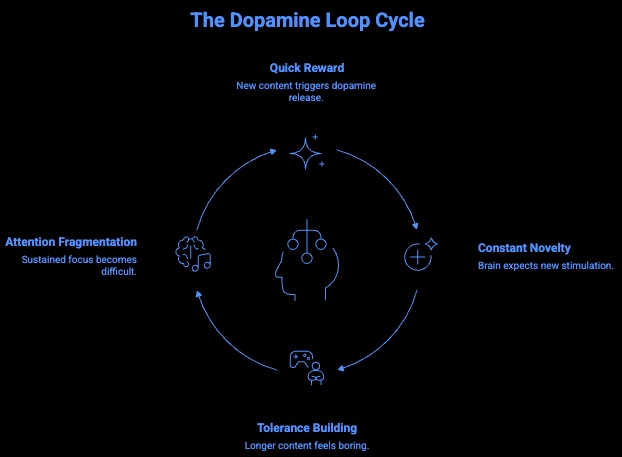
Stage 1: Quick Reward
Every new video gives the brain a tiny hit of dopamine. The brain quickly learns that "new" equals "pleasure."
Stage 2: Constant Novelty
The brain starts to expect a new spark of interest every 15 to 60 seconds. This becomes the baseline for what "not being bored" feels like.
Stage 3: Tolerance Building
Longer videos start to feel like a chore. When a kid is used to 15-second punchlines, a 10-minute science lesson feels like an eternity.
Stage 4: Attention Fragmentation
Deep focus becomes physically difficult. The brain has been trained to jump from one thing to the next, making sustained concentration feel unnatural.
"We're essentially training children's brains to expect entertainment every 15-60 seconds. When they need to read a chapter book or follow a 10-minute lesson, their brain literally isn't wired for it anymore."
— Dr. Jean Twenge, Psychology Professor and author of iGen
The Research: What Studies Actually Show
Key Finding 1: Attention Task Performance
Children who watch 3+ hours of short-form video daily show:
- A 40% drop in performance on tasks requiring sustained attention.
- A 35% increase in errors when switching between tasks.
- A 50% decrease in reading comprehension for anything longer than 500 words.
Key Finding 2: Academic Correlation
A 2024 study of 12,000 students found some worrying trends:
- Heavy short-form video users scored 0.7 grade points lower on average.
- 73% of teachers say it's getting harder to teach lessons that last longer than 5 minutes.
- Reading scores are directly tied to how many hours a kid spends on short-form feeds.
Key Finding 3: The "Swipe Brain" Effect
Short-form video isn't like watching TV. It's active seeking behavior:
- Kids aren't just watching; they are hunting for the next hit. They swipe constantly.
- The average session lasts over 90 minutes, even though the videos are under a minute long.
- "Time blindness" is real—30 minutes of swiping feels like 5 minutes to a child.
Why YouTube Shorts Are Different from Other Screen Time
Not all digital time is the same. Shorts are uniquely problematic compared to a movie or a video game:
The Infinite Scroll Problem
Scroll horizontally to see all columns.
| Feature | Impact |
|---|---|
| No natural stopping point | Kids keep going until someone takes the phone away. |
| Aggressive algorithms | The feed is designed to be addictive. |
| Autoplay | There is no "decision point" where a kid chooses to keep watching. |
| Personalized feed | It removes all friction, showing only what will keep them hooked. |
Content Design Optimization
Creators are fighting for attention, so they optimize for the extreme:
- The 0.5-second hook — If they don't grab the kid instantly, they lose them. This trains the brain to expect instant gratification.
- Sensory overload — Fast cuts, loud music, and bright colors keep the brain in a state of high arousal.
- Emotional bait — Content often relies on shock or outrage to keep engagement high.
- Zero depth — You can't explain anything complex in 60 seconds, so the content stays superficial.
Comparison: Long-Form vs. Short-Form Video
Scroll horizontally to see all columns.
| Long-Form Educational Video | Short-Form Entertainment |
|---|---|
| 10-30 minute lessons | 15-60 second clips |
| Sequential learning | Random, unconnected content |
| Builds sustained attention | Fragments attention |
| Requires focus to understand | Requires no focus |
| Teaches patience | Teaches impatience |
What devices does your child use for YouTube?
What Can Parents Do About YouTube Shorts?
Block Shorts entirely, then replace the habit with long-form content and screen-free downtime. WhitelistVideo blocks Shorts by default on every device (you can allow them again from the parent dashboard), so the feed simply disappears. The three solutions below cover blocking, replacing and rebuilding attention. Device-by-device steps are in how to block YouTube Shorts for kids.
Solution 1: Block Shorts Entirely
The most effective move is to just get rid of them.
WhitelistVideo lets you cut out Shorts while keeping the long-form educational videos that actually have value. This isn't about being "mean"—it's about protecting how your child's brain develops.
How to do it:
- Turn on Shorts blocking in your WhitelistVideo settings.
- Approve the educational channels you trust.
- The Shorts feed simply disappears from their experience.
Solution 2: Replace, Don't Just Remove
If you take away the dopamine hit, you need to fill the gap. Boredom is good for kids, but they need better options to turn to.
Better alternatives:
- Long-form educational YouTube channels (think PBS or specialized science channels).
- Learning apps like Duolingo or Khan Academy.
- Actual books that match their interests.
- Hands-on hobbies that require patience, like building sets or art.
Solution 3: Model Long-Form Engagement
Kids do what we do, not what we say. If they see you scrolling Reels for two hours, they’ll think that’s the norm.
Try this instead:
- Let them see you reading a physical book.
- Watch a full-length documentary together as a family.
- Put your own phone away during dinner or "focus time."
Solution 4: Create "Focus Time" Routines
Attention is a muscle. You have to exercise it.
Scroll horizontally to see all columns.
| Activity | Duration | Attention Benefit |
|---|---|---|
| Reading time | 20-30 minutes | Builds sequential focus |
| Puzzle or building projects | 30-45 minutes | Develops patience |
| Educational documentaries | 45-60 minutes | Long-form engagement |
| Homework without device switching | As needed | Real-world application |
The Long-Term Stakes: Why This Matters
This isn't just about screen time limits. It's about making sure kids have the cognitive skills they'll need as adults.
Academic Success
School is long-form.
- Classes are 45 minutes long, not 45 seconds.
- Reading a novel takes hours of focus.
- Tests require sitting still and thinking deeply.
Career Readiness
No one gets paid to have a 60-second attention span.
- Real-world projects take weeks or months of effort.
- Problem-solving requires staying with a difficult task until it's done.
- Professional growth requires deep, sustained learning.
Relationship Building
Deep connections take time.
- Real conversations don't have "skip" buttons.
- Empathy requires listening to someone for more than a minute.
- Friendships are built on presence, not just quick interactions.
How to Navigate the Transition
If your child is already hooked on Shorts, they’re going to fight back when you change the rules. That’s normal. Here is how to handle it:
Step 1: Explain the Why (Age-Appropriately)
For ages 8-10:
"Your brain is like a muscle. These quick videos are like candy—they taste good but don't help you grow. We're going to focus on 'brain food' videos instead."
For ages 11-13:
"I've noticed it's getting harder for you to focus on your hobbies. The research shows these short videos are the reason. We're going to take a break from them so your brain can reset."
For ages 14+:
"Let's look at the data on how these algorithms work. They are literally designed to keep you scrolling. Let's figure out a way to use YouTube that doesn't mess with your focus."
Step 2: Gradual Reduction
Going cold turkey can be a shock. Try a step-down approach:
- Week 1: Limit Shorts to 30 minutes a day.
- Week 2: Drop it to 15 minutes.
- Week 3: Shorts only on weekends.
- Week 4: Use WhitelistVideo to block them entirely.
Pro tip: YouTube’s Family Link now has a Shorts Timer (as of January 2026). You can set a hard limit that automatically shuts off the Shorts feed while leaving the rest of YouTube open. It’s a great way to enforce the taper.
Step 3: Provide Alternatives
Don't just say "no." Say "not that, but this." If you block Shorts, make sure their Whitelist is full of channels they actually enjoy watching in long-form.
Step 4: Be Consistent
The first week is the hardest. If you give in "just this once," you're teaching them that the rules are negotiable. Stick to the plan.
The Bottom Line
YouTube Shorts are here to stay. They are engineered to be addictive, and they are very good at it.
But as a parent, you get to decide what kind of environment your child grows up in. You can choose to protect their ability to think, focus, and learn.
WhitelistVideo gives you the tools to do that:
- Kill the Shorts feed automatically.
- Keep the educational content that matters.
- Give your child's brain the space it needs to develop.
Focus is a superpower in the modern world. It's worth the effort to protect it.
Key Takeaways
- Short-form video is a focus-killer — Heavy users see a 40% drop in attention span.
- It's a dopamine trap — The constant novelty retrains the brain to hate anything "slow."
- Quality over quantity — Long-form educational videos build the brain; Shorts fragment it.
- Blocking works — Tools like WhitelistVideo let you remove the bad stuff without losing the good.
- Consistency is key — Taper off the usage, explain why, and don't look back.
Protect Their Attention Span
Block Shorts automatically while keeping educational long-form content from channels you approve.
Frequently Asked Questions
Research indicates that consuming short-form content (under 60 seconds) trains the brain to expect constant novelty and rapid stimulation. Children who regularly watch YouTube Shorts show up to 40% reduction in sustained attention tasks compared to peers who primarily consume long-form content. This makes it harder to focus on schoolwork, reading, or any activity requiring concentration beyond one minute.
Yes. WhitelistVideo includes a dedicated Shorts blocking feature that removes all short-form content (Shorts, Stories, and vertical video feeds) while maintaining access to educational long-form videos from channels you've approved. Your child can still watch 10-minute Khan Academy lessons while being completely protected from 15-second entertainment clips.
Child development experts recommend limiting short-form video consumption to under 30 minutes daily for children, with strong preference given to longer educational content. The American Academy of Pediatrics emphasizes that content quality matters more than total screen time, and short-form video is among the lowest-quality content for cognitive development.








Published January 20, 2025 · Updated September 21, 2026

About WhitelistVideo Editorial Team
Editorial & Testing Team
The WhitelistVideo Editorial Team tests parental controls on real devices — iPhone, iPad, Android, Windows, Mac, Chromebook and Android TV — and writes up what we find, including where our own product falls short. Where a claim comes from a vendor's own documentation or from third-party testing, we cite it. Articles are reviewed by Arul Prakash, the founder of WhitelistVideo.
You Might Also Like

Why YouTube Kids Isn't Enough for School-Age Children
YouTube Kids was designed for toddlers, not tweens. Here's why parents of 8-15 year olds need a different approach to safe YouTube access.
YouTube Algorithm: 50+ Stats Every Parent Must Know
YouTube's algorithm controls 70% of what kids watch. Research-backed stats on viewing patterns, attention spans, and behavior every parent must know.
YouTube Shorts Addiction in Kids: The Variable Reward Machine Parents Don't Understand
YouTube Shorts uses slot-machine psychology to hook children. Learn how variable reward schedules create compulsive viewing, why kids are neurologically more vulnerable, and how to block the mechanism without banning YouTube entirely.
Curious what Google knows about us?
Add WhitelistVideo as a trusted source on Google — get instant context on how families keep kids safe on YouTube.
Ask Google about WhitelistVideo