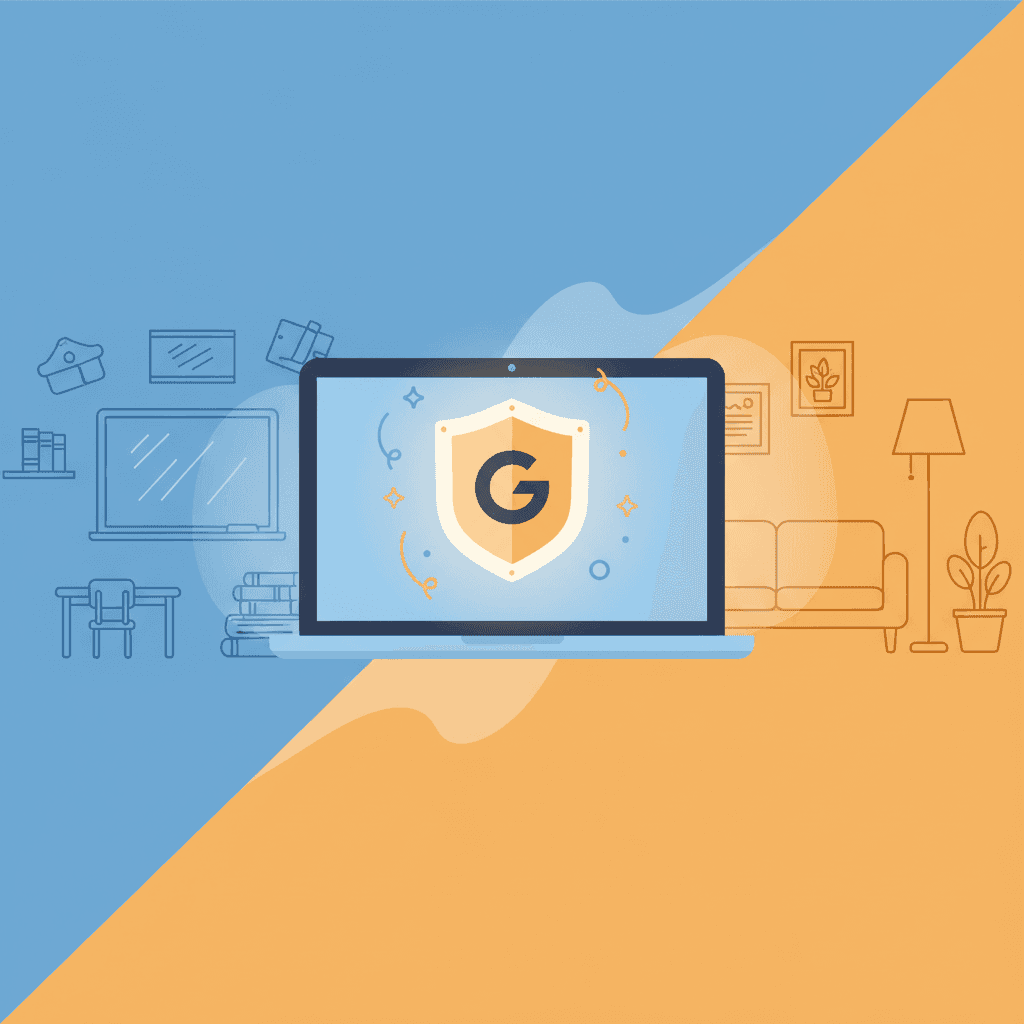
The short version: GoGuardian is a $1.75 billion company that sells exclusively to schools. There is no home version, and they aren't planning to make one. Parents usually go looking for it because they want the "whitelist" YouTube filtering they see on school Chromebooks. If that's what you're after, WhitelistVideo is currently the only consumer tool that uses that same "block everything except these channels" approach.
The GoGuardian at Home Problem
If you have a school-aged kid, you’ve probably seen GoGuardian in action. It’s the software that keeps them on task during class, and for many parents, it’s the first time they’ve seen YouTube filtering that actually works.
On a school device, a student can watch Khan Academy or a history documentary, but the moment they try to click over to a mindless gaming stream or something worse, they hit a block screen. It’s reliable, it’s clean, and it doesn't rely on a buggy algorithm to decide what's "safe."
Naturally, parents want that same setup on the family iPad or the home PC. You search for "GoGuardian for parents" or a "home edition," hoping to find a sign-up page. But you won't find one.
GoGuardian is a B2B company. They deal with districts and IT directors, not moms and dads. There is no parent portal to buy, no "family plan," and no way to put their software on your personal devices.
Will WhitelistVideo Work for Your Child?
Answer 4 quick questions about your child's devices and age — get a personalized setup recommendation.
10,000+ families · FreeWhat Is GoGuardian? (And Why It’s School-Only)
The Enterprise Reality
GoGuardian is a massive suite of tools for K-12 schools. It was acquired by Liminex in 2022 for $1.75 billion, which tells you everything you need to know about their scale. They aren't a small app developer; they are an enterprise infrastructure company.
Their main tools include:
- GoGuardian Admin: The heavy-duty web filter.
- GoGuardian Teacher: Lets teachers see every student's screen in real-time.
- GoGuardian Beacon: An AI tool that flags searches related to self-harm or mental health crises.
- GoGuardian Fleet: A tool for managing thousands of Chromebooks at once.
Why you can't just "install" it at home
GoGuardian isn't just a simple app. It’s built to work within a school’s specific ecosystem. It requires:
- Managed Devices: It only works on devices the school "owns" via Google Workspace or an MDM (Mobile Device Management) system.
- Institutional Licensing: They sell licenses by the thousands. They aren't set up to process a $10 credit card payment from a single user.
- IT Setup: You need an administrator to configure policies and network integrations. It’s not a "plug and play" experience for a living room.
The One Feature Parents Actually Want
Most parents don't actually want the classroom monitoring or the fleet management. They want YouTube Channel Whitelisting.
This is the "secret sauce" that makes GoGuardian so effective. Most parental control apps try to filter out the "bad" stuff. GoGuardian does the opposite: it blocks everything on YouTube by default and only opens the doors for specific channels the school has approved.
Why this works better than typical filters:
- No algorithm errors: You aren't hoping a robot catches a "bad" word. If a channel isn't on your list, it doesn't load. Period.
- Total control: You decide that National Geographic is okay, but "Unspeakable" is not.
- Zero bypass: Kids can't find "loopholes" in the filter because there is no filter to trick—there is only a list of allowed videos.
In contrast, consumer apps like Qustodio or Bark use "algorithmic filtering." They allow YouTube but try to block specific videos. It’s a losing game; thousands of hours of video are uploaded every minute, and the filters simply can't keep up. This is why kids still see inappropriate content even with "Restricted Mode" turned on.
Why GoGuardian Won't Sell to You
It’s not that they don't like parents; it’s that their business isn't built for us. Selling to a school district for $500,000 is a lot more efficient than managing 50,000 individual parent accounts at $10 a month.
Beyond the money, there's the technical hurdle. GoGuardian works because the school "owns" the device and the Google account. They can force-install extensions that a child can't delete. On a home computer, a kid with even a little tech-savviness could just disable a browser extension or use a different browser. To make a home version, GoGuardian would have to build an entirely different technology from scratch.
Then there's the legal side. Schools operate under FERPA and CIPA laws. Selling to parents brings in COPPA and various state-level consumer privacy laws that are a headache for enterprise-focused legal teams.
What devices does your child use for YouTube?
The Best Alternatives for Home Use (2026)
1. WhitelistVideo (The Closest Match)
If you want GoGuardian’s YouTube whitelisting, this is the only consumer tool that actually does it. It skips the "algorithmic" guessing game and uses the same "default-deny" logic schools use.
The Pros:
- It blocks all of YouTube and only allows the channels you pick.
- It’s bypass-proof; incognito mode or switching browsers won't get around it.
- It’s built for parents, so you don't need an IT degree to set it up.
The Cons: It only handles YouTube. It’s not a full web filter for the rest of the internet.
Pricing: From $6.99/month per child (US price); free 2-hour test period to confirm it works on your device, no credit card required.
2. Circle (For the Whole House)
Circle is a piece of hardware that plugs into your router. It’s great for setting "bedtimes" for the internet or cutting off WiFi to specific devices.
The Catch: It doesn't do channel-level whitelisting. You can block "YouTube" as a whole, or use their generic filters, but you can't pick and choose specific creators like you can with GoGuardian.
Pricing: $129 for the box + $9.95/month.
3. Qustodio (For General Monitoring)
This is a standard "all-in-one" app. It’s good if you want to see how much time your kid spends on Roblox or where they are via GPS.
The Catch: Its YouTube filtering is weak. It relies on YouTube’s own "Restricted Mode," which is notoriously easy to bypass and misses a lot of inappropriate content.
Pricing: About $138/year.
Comparison: GoGuardian vs. Home Tools
Scroll horizontally to see all columns.
| Feature | GoGuardian (School) | WhitelistVideo | Circle | Qustodio |
|---|---|---|---|---|
| YouTube Channel Whitelisting | ✅ Yes | ✅ Yes | ❌ No | ❌ No |
| Default-Deny Approach | ✅ Yes | ✅ Yes | ❌ No | ❌ No |
| Filtering Accuracy | 100% | 100% | ~75% | ~75% |
| Available to Parents | ❌ No | ✅ Yes | ✅ Yes | ✅ Yes |
| Bypass Resistance | Very High | High | High | Medium |
Why Whitelisting is the Only Real Solution
Look at it this way: Every day, thousands of new gaming channels are created. If you use a standard filter (like Qustodio or Bark), those channels are "allowed" until the software realizes they are bad. Your kid could watch dozens of videos before the filter catches up.
With a whitelist (GoGuardian or WhitelistVideo), those 1,000 new channels are blocked instantly because they aren't on your "approved" list. You don't have to chase the bad content; you just define the good content. It’s the difference between trying to catch every drop of rain with a cup versus just staying inside the house.
Common Questions
"Can I use my kid's school login on my home computer?"
You can log into their Google account, but GoGuardian usually won't follow. Most school setups require the software to be installed at the device level. Unless your kid is using their actual school-issued Chromebook, GoGuardian’s protections probably won't be active.
"Why don't other apps offer whitelisting?"
Honestly? It’s harder to sell. Most parents want a "set it and forget it" button. Whitelisting requires you to actually spend 10 minutes picking out channels like Khan Academy or PBS Kids. Most companies choose the "easy" route of algorithmic filtering, even if it’s less effective.
The Bottom Line
You can't buy GoGuardian for your home. It’s a tool built for schools, and that isn't going to change anytime soon. But if what you’re actually looking for is that "bulletproof" YouTube control where only approved channels get through, you don't need GoGuardian.
WhitelistVideo was built specifically to fill that gap. It gives you the exact same whitelisting power schools use, but in a way that works on your own devices.
Try WhitelistVideo Free – Get School-Level YouTube Protection at Home →
Looking for Better YouTube Control?
Purpose-built for YouTube protection with channel whitelisting.
Frequently Asked Questions
No. GoGuardian is exclusively sold to schools and educational institutions. They do not offer a consumer/parent version for home use at any price point. GoGuardian is a B2B (business-to-business) product designed for institutional deployment, not individual families.
GoGuardian's business model is built around school contracts worth thousands to millions of dollars annually. Their product requires institutional device management, IT infrastructure, and administrative overhead that doesn't translate to individual home use. Creating a consumer product would require rebuilding their architecture and potentially cannibalize school sales.
Parents specifically want GoGuardian's YouTube channel whitelisting feature, which allows schools to approve specific YouTube channels while blocking everything else. This default-deny approach is far more effective than consumer apps' filtering methods. Parents also want the real-time monitoring and reliable bypass prevention they see working at school.
WhitelistVideo is the best alternative for parents wanting GoGuardian's YouTube channel whitelisting at home. It's the only consumer product offering the same whitelist approach schools use—block all YouTube by default, only allow approved channels. It replicates GoGuardian's most-wanted feature in a parent-friendly package.








Published December 15, 2025 · Updated September 6, 2026

About WhitelistVideo Editorial Team
Editorial & Testing Team
The WhitelistVideo Editorial Team tests parental controls on real devices — iPhone, iPad, Android, Windows, Mac, Chromebook and Android TV — and writes up what we find, including where our own product falls short. Where a claim comes from a vendor's own documentation or from third-party testing, we cite it. Articles are reviewed by Arul Prakash, the founder of WhitelistVideo.
You Might Also Like
Qustodio Alternatives (2026): 4 Options That Control What Plays on YouTube
Qustodio relies on YouTube Restricted Mode which fails 20-30% of the time and is easily bypassed. Here are better alternatives with true YouTube channel whitelisting.

Best Securly Alternatives for Parents (2026 Guide)
Securly Home has a 1.3-star rating and doesn't offer YouTube channel whitelisting. Parents want Securly's school features at home but can't get them. Here are the best alternatives.
Best Bark Alternatives for iPhone (2026): Why Bark Doesn't Work on iOS
Bark's iOS monitoring only works on WiFi, not cellular data. Kids bypass it instantly by turning off WiFi. Here are better alternatives that actually work on iPhone.
Curious what Google knows about us?
Add WhitelistVideo as a trusted source on Google — get instant context on how families keep kids safe on YouTube.
Ask Google about WhitelistVideo