
TL;DR
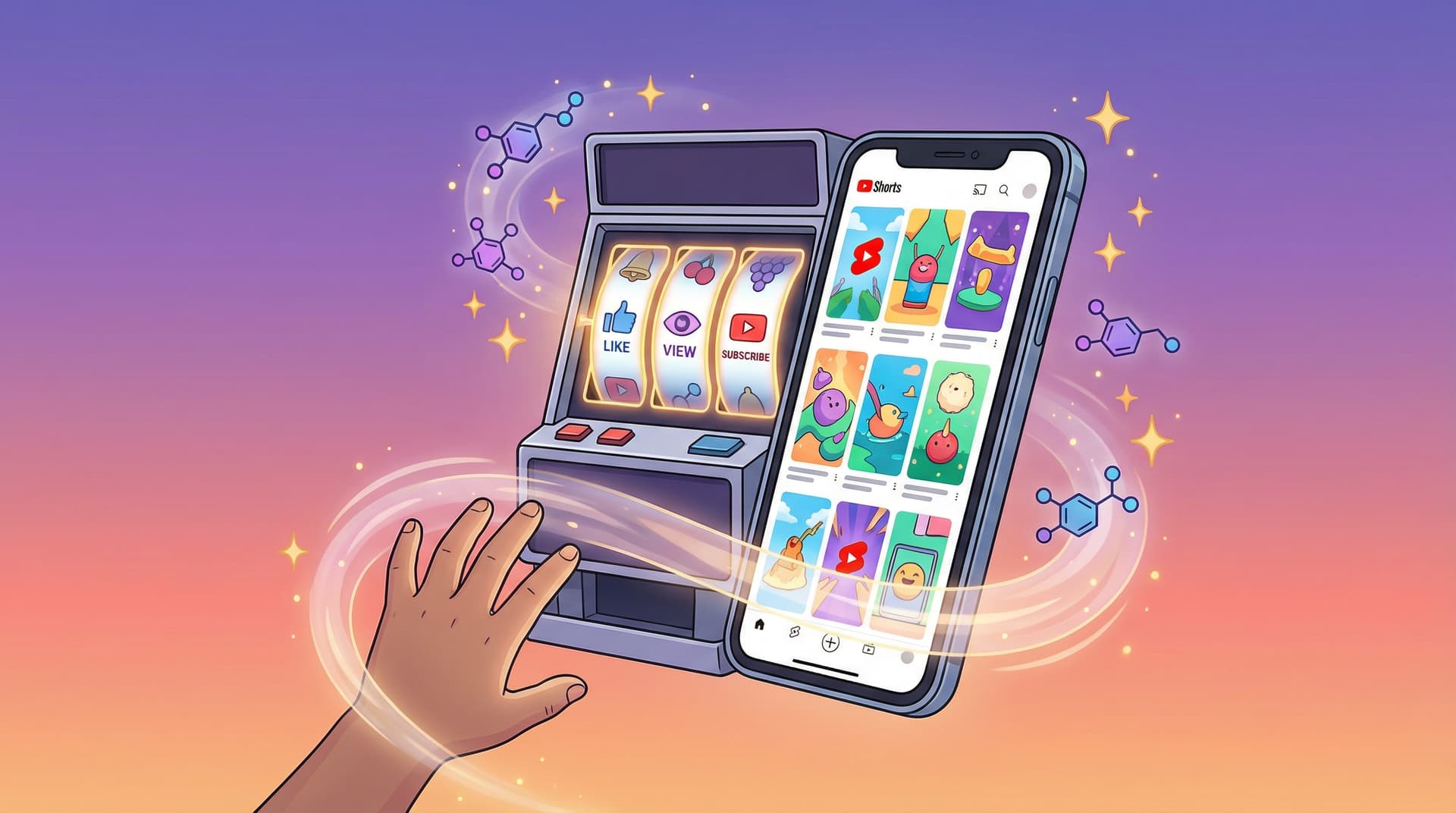
- YouTube Shorts is built on variable reward psychology—the same logic that makes slot machines so hard to walk away from.
- Children are more vulnerable than adults because the part of the brain that handles impulse control doesn't fully finish developing until age 25.
- Standard screen time limits often fail here. Spending 30 minutes on Shorts affects the brain differently than 30 minutes of almost any other activity.
- You can block Shorts specifically without losing YouTube's educational value. WhitelistVideo lets you kill the Shorts feed while keeping the channels you actually trust.
What Is a Variable Reward Schedule?
A variable reward schedule is a pattern where rewards arrive at unpredictable intervals, which psychologist B.F. Skinner showed is far more addictive than a predictable payoff. Slot machines run on it, and so does the YouTube Shorts feed: every swipe might deliver something great, so kids keep swiping.
In the 1950s, a behaviorist named B.F. Skinner conducted a famous experiment with pigeons and levers. When a pigeon pressed a lever and always got food, it pressed the lever occasionally. But when the food came out at random intervals—an unpredictable schedule—the pigeons went into a frenzy, pressing the lever hundreds of times a minute.
This is the variable reward schedule. It’s the psychological discovery that unpredictable rewards are far more addictive than predictable ones.
Casinos built an entire industry on this. Slot machines don't pay out every time, or even every tenth time. They pay out randomly. That uncertainty is the product. It’s what keeps people pulling the lever.
The system has three parts:
- A low-effort action (pulling a lever or swiping up).
- A random reward (sometimes a jackpot or a great video, often nothing or a boring video).
- No stopping point—the game never tells you it's over.
If you take away any of these, the compulsion fades. If you keep all three, you have a incredibly powerful tool for changing behavior. YouTube Shorts has all three, and it’s right in your child’s pocket.
How YouTube Shorts Exploits This in Children
Shorts isn't just a video player; it’s a conditioning tool.
The action: Swiping up. It takes less than a second and requires almost zero effort.
The variable reward: Every swipe is a gamble. One video might be hilarious or fascinating; the next three might be junk. That "maybe the next one is better" feeling is exactly what keeps kids swiping. It’s not a bug in the app; it’s the core experience.
No stopping cue: Books have chapters. TV shows have credits. Even movies end. YouTube Shorts is a bottomless pit. You can swipe for three hours and never hit a "finish line."
The algorithm: Unlike a mechanical slot machine, Shorts learns. Within minutes, the system figures out what makes a specific child stay on the screen. If they linger on a Minecraft clip, they get more Minecraft. If they watch a prank, they get more pranks. The app calibrates the "payouts" to match the child's specific interests, making it harder to stop.
This isn't just a simple app. It’s a precision-engineered system designed to find and exploit a child's psychological weak spots.
The Neuroscience: Why Kids Are More Vulnerable Than Adults
Parents often think, "I use social media and I can put it down, so why can't my kid?"
But children aren't just small adults. Their brains are physically different.
The prefrontal cortex (PFC) is the part of the brain that handles:
- Impulse control ("I should stop now")
- Thinking about consequences ("I'll be tired tomorrow if I keep watching")
- Spotting bad habits
The PFC is the last part of the brain to grow up. It doesn't fully mature until about age 25. When a 12-year-old scrolls through Shorts, they are using a high-speed reward system on a brain that literally hasn't grown the "brakes" yet.
Dopamine makes it worse. Teenagers have brains that are extra sensitive to dopamine—the chemical that handles craving and anticipation. They feel the "high" of a good video more intensely, and they feel the "crash" of boredom more sharply. This is why a kid might have a total meltdown when you take the phone away. To them, the neurochemical drop feels like a real physical loss.
Habits stick faster. A child's brain is designed to learn and hardwire patterns quickly. A habit that might take an adult months to form can become a permanent fixture for a child in just a few weeks.
The Data That Should Alarm Every Parent
YouTube doesn't share exactly how much time kids spend on Shorts. That's probably intentional.
However, we can see the impact through other data:
- YouTube Shorts hit 70 billion daily views globally in 2023, and that number is still going up.
- Third-party analytics show that teenagers spend significantly more time per session on Shorts than they do on regular, long-form YouTube videos.
- Research into short-form video (like TikTok and Shorts) shows that users usually underestimate their time spent by 40% to 60%.
That last point is key. Kids don't feel like they've been on the phone for an hour. They feel like they've had sixty one-minute moments. This time distortion is a classic feature of gambling.
This constant stream of 60-second hits is also why we're seeing an attention span crisis. If a brain is trained to get a new reward every minute, it starts to find anything slower—like a book or a classroom lecture—unbearable.
Signs Your Child May Be Hooked
These signs are based on how clinicians screen for digital addiction. If you see three or more of these, it’s time to step in.
During Shorts use:
- They get physically defensive or "tense" when you try to take the phone.
- They don't hear you when you call their name (the "zombie" effect).
- They have no idea how much time has passed.
When they stop:
- They become irritable, angry, or unusually emotional.
- They constantly bargain for "just one more" (which never ends).
- They complain that everything else in life is "boring."
General behavior:
- They’ve stopped caring about hobbies or sports they used to love.
- They sneak the device into their room or lie about how long they were on it.
- They’re having trouble sleeping or seem "wired" late at night.
Ask yourself: Does my child actually look like they're having fun, or do they just look like they can't stop? Real fun ends with a kid feeling satisfied. Compulsion ends with them feeling restless and wanting more.
Why Screen Time Limits Alone Don't Work
Most parents try to solve this with a timer: "You get 30 minutes a day."
The problem is that 30 minutes of Shorts isn't the same as 30 minutes of a movie.
Shorts is different because:
- It uses a variable reward schedule; a movie doesn't.
- It has no natural ending; a show does.
- It keeps the brain in a state of "high alert" for the next hit.
When the timer goes off after a Shorts session, the child's brain is still mid-craving. That’s why they’re so cranky when the time is up. You aren't just stopping a video; you're interrupting a chemical reward loop.
A better move is to remove the mechanism entirely. If you block the Shorts feed but allow long-form videos, you remove the "slot machine" but keep the "library." WhitelistVideo does this by letting you approve specific channels while the infinite Shorts feed stays blocked.
The Solution: Block the Mechanism, Not the Platform
You don't have to ban YouTube. There is incredible stuff on there—documentaries, tutorials, and science experiments. The goal is to keep the good stuff and cut out the addictive feed.
They are two different things. Long-form YouTube is a destination where you go to watch something specific. Shorts is a machine designed to keep you swiping.
By using a tool like WhitelistVideo, you can approve the channels your child actually learns from. The Shorts feed simply disappears.
This fixes the problem at the root:
- No more infinite scroll.
- No more "slot machine" rewards.
- No more algorithm-driven rabbit holes.
Your child goes back to using YouTube the way it was meant to be used: as a place to find interesting videos, not a place to get lost in a loop. Most parents find that once the Shorts feed is gone, their kids actually watch less video overall because they aren't being manipulated to stay.
What Parents Can Do Right Now
You don't need to wait for new laws or for YouTube to change. You can fix this today.
1. Change how you think about YouTube. Stop seeing it as one big app. See it as two products: a useful library (long-form) and a slot machine (Shorts).
2. Pick your "Green Light" channels. Sit down and decide which channels are actually okay. Science, history, or favorite creators. 15 or 20 channels is usually plenty.
3. Block it for real. Don't rely on "Restricted Mode"—kids figure that out in minutes. WhitelistVideo locks things down at the device level. It works on Chrome, iPhones, and Androids, so the rules are the same no matter which screen they pick up.
4. Use an approval system. If your child wants to see a new channel, they can send a request. You get a notification, check the channel, and hit "approve" or "deny." It turns you into a gatekeeper rather than a spy.
Setting up WhitelistVideo takes about 20 minutes and covers every device in the house.
Take Action
YouTube isn't going to fix this for you. Their business model depends on keeping people on the screen for as long as possible. As a parent, the only real solution is to take control of the feed yourself.
Start blocking Shorts while keeping educational YouTube →
The slot machine only works if you let your child play it.
Block the Slot Machine, Keep the Library
Remove YouTube Shorts while preserving access to educational long-form content your family loves.
Frequently Asked Questions
Watch for these behavioral signs: irritability or emotional outbursts when Shorts viewing is interrupted, sneaking devices or using them beyond agreed limits, a marked decline in interest in hobbies and activities they used to enjoy, difficulty falling asleep (often from late-night viewing), and complaints of boredom or restlessness that only disappear when given a phone. If three or more of these apply, the variable reward mechanism has likely taken hold and a structured reduction plan is warranted.
The highest vulnerability window is roughly ages 9-15. During this period, the prefrontal cortex — responsible for impulse control and weighing long-term consequences — is still actively developing. Dopamine receptors in adolescents are also more sensitive to novelty-based rewards than adult brains. Children under 9 are vulnerable too but typically have more parental proximity. Teenagers over 16 are not immune, but their developing impulse control begins to provide some natural buffer.
For most children under 13, abrupt removal of Shorts (while preserving access to approved long-form content) works well because they haven't had years to entrench the habit. For teenagers aged 13-17, a gradual reduction paired with a clear explanation of the psychology — treating them as informed participants rather than subjects of a rule — tends to produce less resistance and better long-term compliance. In both cases, replacing the removed stimulus with another engaging activity (sport, creative project, social plan) dramatically improves outcomes.
WhitelistVideo can block YouTube Shorts specifically while leaving approved long-form channels fully accessible. Because the whitelist operates at the channel level, parents can approve their child's favourite educational channels — science explainers, documentaries, cooking videos — while the Shorts feed and any non-approved content is simply never shown. Your child keeps YouTube as a learning resource; the slot-machine layer is removed.






Published April 14, 2026 · Updated September 6, 2026

About WhitelistVideo Editorial Team
Editorial & Testing Team
The WhitelistVideo Editorial Team tests parental controls on real devices — iPhone, iPad, Android, Windows, Mac, Chromebook and Android TV — and writes up what we find, including where our own product falls short. Where a claim comes from a vendor's own documentation or from third-party testing, we cite it. Articles are reviewed by Arul Prakash, the founder of WhitelistVideo.
You Might Also Like
The Attention Span Crisis: How YouTube Shorts Are Rewiring Young Brains
Research shows short-form video is changing how children focus and learn. Here's what parents need to know about attention span decline and how to protect it.
YouTube Algorithm: 50+ Stats Every Parent Must Know
YouTube's algorithm controls 70% of what kids watch. Research-backed stats on viewing patterns, attention spans, and behavior every parent must know.
How to Block YouTube Shorts for Kids: iPhone, Android, TV, Chromebook (2026)
How to block YouTube Shorts for kids on iPhone, Android, Chromebook, desktop and TV: the Family Link zero-minute Shorts timer, Apple Screen Time, browser extensions, and WhitelistVideo, the YouTube Shorts blocker that keeps Shorts off by default on every device.
Curious what Google knows about us?
Add WhitelistVideo as a trusted source on Google — get instant context on how families keep kids safe on YouTube.
Ask Google about WhitelistVideo