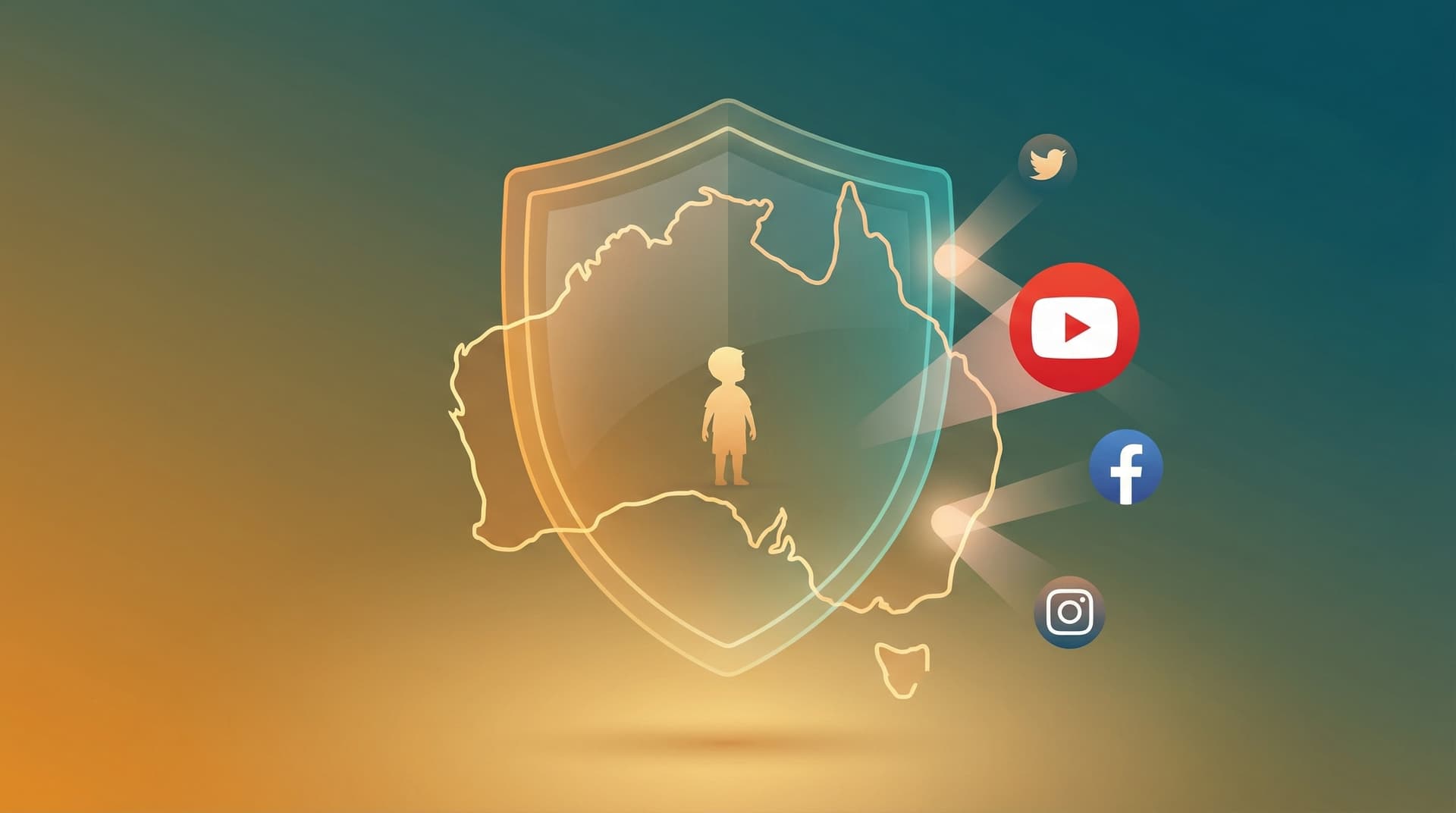

Update — August 2026: The ban has now been enforced for roughly eight months. The eSafety Commissioner has issued initial compliance guidance to platforms, and YouTube's supervised-accounts experience remains removed for Australian under-16s. The core takeaway of this piece — that Australian parents are left with fewer built-in YouTube controls after the ban than before it — still stands. See the "Eight months in" section below for what's changed since December 2025.
TL;DR: Australia's Online Safety Amendment Act came into force in December 2025, banning social media for children under 16. Platforms including YouTube were required to verify user ages and restrict access for minors. YouTube's response was to remove its supervised account experience for under-16s in Australia — eliminating the one built-in tool parents had for managing their child's YouTube access. An estimated 4.7 million under-age accounts were removed or restricted across platforms. Kids didn't stop watching YouTube; they found ways around it. Australian parents who relied on supervised accounts now have fewer controls than before the ban.
What Australia's Online Safety Amendment Act Actually Says
The Online Safety Amendment (Social Media Minimum Age) Act 2023 passed the Australian Parliament in November 2024 and came into force in December 2025. It established a minimum age of 16 for social media use in Australia — the first law of its kind at this scale anywhere in the world.
Key provisions of the law:
- Minimum age of 16: Platforms must take "reasonable steps" to prevent under-16s from holding accounts
- Platform liability: Penalties of up to AUD 49.5 million for systemic non-compliance
- Platforms covered: Instagram, TikTok, Facebook, Snapchat, X (Twitter), Reddit — and YouTube
- Age verification: Platforms must implement age-assurance mechanisms, though the specific method is left to each company
- No parental consent override: Unlike similar proposals in other countries, Australian parents cannot consent on behalf of their child to grant access
The intent was clear: reduce the harm that comes from young children being exposed to algorithmically-driven social media content before their critical thinking is developed enough to handle it. The execution, however, created an unintended consequence for parents of YouTube-watching children.
Will WhitelistVideo Work for Your Child?
Answer 4 quick questions about your child's devices and age — get a personalized setup recommendation.
10,000+ families · FreeThe YouTube Fallout: Supervised Accounts Removed
Before the ban, YouTube offered a "supervised accounts" feature that gave parents meaningful control over what their children could access. A parent could link their child's Google account to their own, set content restrictions, approve or block channels, and monitor watch history. It wasn't perfect, but it was functional.
When the Australian legislation took effect, YouTube faced a choice: build robust age verification infrastructure for Australian users under 16, or withdraw features that would have required maintaining accounts for that age group. YouTube chose the latter.
Supervised accounts were removed for under-16 users in Australia. Parents who had configured the feature found it simply gone — no migration path, no alternative offered. Children either transitioned to standard YouTube accounts with no parental oversight, or they lost access through the main YouTube app and found other ways to watch.
The outcome was the opposite of what the legislation intended. Parents had less control after the ban than before it.
4.7 Million Accounts Removed — What Happened Next
Across all regulated platforms, an estimated 4.7 million accounts belonging to under-16 Australians were removed or restricted in the months surrounding the December 2025 enforcement date. On paper, that looks like a success for child safety policy.
In practice, the picture is more complicated:
- Age verification is easy to fake: Most platforms used self-declared age as their "reasonable step." A 14-year-old who enters a false birthdate passes immediately.
- VPN adoption surged: Downloads of free VPN apps among Australian teenagers increased sharply in the weeks around the enforcement date, as kids sought to appear as if they were accessing from outside Australia.
- Migration to uncontrolled access: Children moved from supervised or age-appropriate accounts to adult accounts, or accessed content through friends' devices, browser-based YouTube without accounts, or alternative apps.
- YouTube usage continued: YouTube is not a social media platform in the traditional sense — it is primarily a video content platform. Many children who were affected by account removal simply continued watching via browser or alternative means.
The ban reduced the number of under-16 social media accounts. It did not meaningfully reduce the amount of uncontrolled YouTube content those children consumed.
What devices does your child use for YouTube?
The Control Gap: What Parents Lost
To understand what Australian parents lost, it helps to compare the before and after:
Scroll horizontally to see all columns.
| Feature | Before December 2025 | After December 2025 |
|---|---|---|
| Supervised accounts | Available — channel approvals, watch history, content restrictions | Removed for under-16s in Australia |
| Content filtering | Supervised mode + Restricted Mode | Restricted Mode only |
| Channel-level control | Yes (via supervised accounts) | No built-in option |
| Watch history visibility | Yes (for parents linked via supervised accounts) | No |
| Approval workflow | Parents could approve or block specific channels | Not available |
What remains is Restricted Mode — a blunt filter that YouTube itself warns is not reliable and should not be used as a primary safety tool. As covered in detail in our Restricted Mode review, the feature misses between 20–30% of genuinely inappropriate content, and children can disable it in seconds by signing out or opening an incognito window.
For Australian parents, the legislative change that was supposed to increase child safety online left them with a single unreliable tool where they previously had several.
What Australian Parents Should Do Now
The policy landscape has changed. YouTube's built-in controls for Australian under-16s have been stripped back. The practical path forward involves working around what YouTube has removed — not waiting for it to come back.
Concrete steps for Australian parents right now:
- Do not rely on Restricted Mode as your primary control. It is a voluntary filter with multiple well-known bypass methods. Treating it as meaningful protection gives a false sense of security.
- Enable YouTube Kids for younger children (under 10). The YouTube Kids app is a separate, more locked-down experience that is still available in Australia. It has algorithm controls and content categories. The trade-off is that kids outgrow it, and content selection is limited.
- Use device-level controls as a complement, not a replacement. Apple Screen Time and Google Family Link can restrict YouTube access at the device level, but they cannot control which channels or content types are accessible within YouTube itself.
- Consider a third-party YouTube control tool that operates independently of YouTube's own account system. This is the most robust option for children aged 10 and older who have moved past YouTube Kids.
- Have the conversation. Children who understand why limits exist — and who have some input into what those limits look like — are more likely to respect them than children who encounter unexplained restrictions.
How WhitelistVideo Fills the Gap
WhitelistVideo was built to solve the problem that YouTube's own parental controls have always struggled with: giving parents genuine channel-level authority over what their children can watch, across every device, without depending on YouTube's internal account features.
That independence is now especially relevant for Australian families. Because WhitelistVideo operates at the browser and device level — not through YouTube's account system — it is not affected by YouTube's decision to remove supervised accounts in Australia.
What WhitelistVideo provides:
- Channel-level whitelisting: Parents approve specific channels. Everything else is blocked. Not filtered — blocked.
- Works on all devices: Windows, Mac, Chromebook, iPhone, iPad, and Android. The same approved channel list applies across all of them.
- Not dependent on YouTube's account features: Functions regardless of whether a child is signed in, signed out, or what YouTube decides to do with its Australian product features.
- Bypass-resistant: Incognito mode and sign-out bypass methods — the two easiest workarounds for Restricted Mode — do not work against WhitelistVideo.
- Auto-pilot mode (Premium): For parents who want broader category-based filtering rather than a strict channel list, Auto-pilot provides an additional layer of content-type controls.
Australian parents can learn more and start a free 2-hour test period at whitelist.video/australia. Setup takes under ten minutes on most devices.
The law changed what YouTube offers in Australia. It did not change what parents can choose to put in place themselves.
Protection for the Devices Your Child Uses
Eight Months In: What's Actually Changed (August 2026)
By mid-2026, enforcement of the under-16 rules has settled into a pattern. Here's what Australian parents are actually experiencing on the ground:
- eSafety Commissioner guidance has firmed up. The Commissioner published detailed "reasonable steps" expectations for age-restricted platforms, covering age-assurance methods, account-detection procedures, and reporting cadence. YouTube, Meta, TikTok, Snap and Reddit are all named in the current guidance set.
- YouTube supervised accounts remain removed for Australian under-16s. There has been no announced restoration path. Existing supervised links created before December 2025 have not been reinstated.
- Signed-out YouTube in the browser is still fully accessible. The ban targets account creation and platform account features — not the public YouTube web player. This is the single biggest gap parents notice: their child can open a browser and watch anything, with zero platform-side controls.
- YouTube Kids remains fully available. It is classified as a children's service, not social media, and sits outside the age restriction. For under-10s this is still the recommended free baseline.
- VPN usage among under-16s remained elevated relative to pre-ban levels throughout the first two enforcement quarters, according to third-party mobile-analytics trackers. Age-restriction bypass is the primary driver.
- State education departments have not standardised on any single filtering tool for school-managed devices. School Chromebook filtering still varies district by district; parent-installed controls only affect home and personal devices.
None of this changes the practical advice: for children aged 8 and up, a device-level or browser-level tool that operates independently of YouTube's account system is now the only way to get meaningful channel-level control. The ban restructured what YouTube offers here — it did not create new parental tools.
For the current eSafety Commissioner guidance and the age-restricted service list, see the eSafety Commissioner: Social media age limits page.
YouTube Controls That Don't Depend on Platform Policy
WhitelistVideo gives Australian parents channel-level YouTube protection that works on every device — independent of YouTube's account system and unaffected by future platform policy changes.
Start your free 2-hour test period and have it set up in under 10 minutes.
Lost Your YouTube Controls?
Australian parents: get channel-level YouTube protection that works regardless of platform policy changes.
Frequently Asked Questions
YouTube is listed as a regulated platform under Australia's Online Safety Amendment (Social Media Minimum Age) Act 2023, which took effect in December 2025. However, YouTube's response to the law — removing supervised account features for under-16s in Australia — has left parents with fewer built-in controls than before, not more.
YouTube removed the supervised accounts experience for users under 16 in Australia following the social media ban legislation. Parents who had set up supervised accounts to control their child's YouTube access lost those controls. Children were either moved to standard unmanaged accounts or lost access entirely.
Yes, VPNs are a widely used workaround for geo-based platform restrictions. A child using a VPN can appear to be in a different country, bypassing Australia-specific age verification requirements. This is one reason why platform-level bans have limited practical effectiveness without device-level controls.
Yes. WhitelistVideo works in Australia on Windows, Mac, Chromebook, iOS, and Android. It operates independently of YouTube's account system and Australian-specific platform policies — meaning the controls it provides are not affected by YouTube's decision to remove supervised accounts in Australia.
Given that YouTube has removed supervised accounts for under-16s in Australia, the most reliable option is a third-party tool that operates independently of YouTube's own features. WhitelistVideo restricts YouTube to a parent-approved list of channels and works across all devices, regardless of what YouTube decides to do with its own parental features.






Published April 2, 2026 · Updated September 7, 2026

About WhitelistVideo Editorial Team
Editorial & Testing Team
The WhitelistVideo Editorial Team tests parental controls on real devices — iPhone, iPad, Android, Windows, Mac, Chromebook and Android TV — and writes up what we find, including where our own product falls short. Where a claim comes from a vendor's own documentation or from third-party testing, we cite it. Articles are reviewed by Arul Prakash, the founder of WhitelistVideo.
You Might Also Like
Is YouTube Really Safe for Kids? Educational Goldmine or Algorithmic Trap?
The ultimate parent guide to YouTube safety. Discover the truth about YouTube's algorithm, global regulations, and a smarter solution that puts parents back in control.

YouTube Restricted Mode: Does It Actually Work? (Tested)
We tested YouTube Restricted Mode and found it misses 20-30% of inappropriate content. See what it blocks, what slips through, and how kids bypass it in seconds.
7 Ways Kids Bypass YouTube Restricted Mode (And Fixes)
YouTube Restricted Mode is shockingly easy to bypass. Learn the 7 specific methods kids use to circumvent it—and why whitelist controls are the only approach that actually works.
Curious what Google knows about us?
Add WhitelistVideo as a trusted source on Google — get instant context on how families keep kids safe on YouTube.
Ask Google about WhitelistVideo