
The Short Answer: Does the Ban Include YouTube?
Yes, in several countries. Australia, the UK, Indonesia, and Brazil have all wrapped YouTube into their social media restrictions for kids under 16. While the US, EU, and India haven't passed federal bans yet, state laws and new proposals are quickly moving that way.
Here is how the current rules look:
مرر أفقياً لرؤية جميع الأعمدة.
| Country | YouTube Banned for Kids? | Effective Date | Age Threshold |
|---|---|---|---|
| Australia | Yes | December 2025 | Under 16 |
| United Kingdom | Yes | Spring 2027 | Under 16 |
| Indonesia | Yes | March 2026 | Under 16 |
| Brazil | Restricted | March 2026 | Under 16 |
| United States | No federal ban | N/A | Varies by state |
| EU | No | N/A | N/A |
| India | No (yet) | May 2027 expected | Under 18 proposed |
One thing to keep in mind: YouTube Kids is exempt everywhere. Also, parents aren't the ones on the hook for fines—the legal weight is entirely on the platforms.
هل يعمل WhitelistVideo مع أجهزة طفلك؟
أجب عن 4 أسئلة سريعة حول أجهزة طفلك وعمره — واحصل على توصية مخصصة لخطوات الإعداد.
أكثر من 10,000 عائلة · مجانيIs YouTube Actually Social Media?
This is the legal sticking point. If a government decides YouTube is social media, the ban applies. If they see it as just a video site, it doesn't.
Most recent laws classify YouTube as social media because it checks three boxes: user profiles, social features (likes and comments), and algorithmic feeds. Even if you just use it to watch DIY videos, those interactive features make it "social" in the eyes of regulators.
Australia’s eSafety Commissioner and the UK’s Technology Secretary have both called out YouTube by name. Indonesia even labeled it "high-risk social media." For most governments, the debate is over.
The exception is YouTube Kids. Because it lacks open comments and uses curated content rather than a raw algorithm, it’s treated as an entertainment app rather than a social network. It remains legal for all ages everywhere.
Countries Where YouTube IS Banned for Kids
Australia: Live Since December 2025
Australia led the charge with the Online Safety Amendment Act. It basically tells platforms they cannot provide accounts to anyone under 16.
Since the law went live:
- More than 4.5 million accounts belonging to minors were deactivated.
- Platforms can be fined up to A$49.5 million for letting kids sign up.
- YouTube Kids is still up and running.
- Platforms—not parents—are responsible for verifying ages.
In practice, it’s a bit of a mess. Kids are already using VPNs or their parents' logins to get around the blocks. The eSafety Commissioner knows there are gaps, but argues the law forces platforms to take safety more seriously.
For parents in Australia, the main change is that your child can't legally have their own account. But if they’re tech-savvy, the law isn't a physical barrier.
United Kingdom: Starting Spring 2027
In June 2026, the UK confirmed YouTube would be part of its under-16 ban. Platforms have until early 2027 to figure out how to block young users.
What we know about the UK ban:
- YouTube is grouped with TikTok, Instagram, and Snapchat.
- WhatsApp and other messaging apps are currently safe from the ban.
- Ofcom will set the rules for how platforms verify age.
- YouTube Kids stays exempt.
The UK is trying to avoid Australia's growing pains by demanding "age assurance" technology. They want more than just a "click here if you're 18" box, though exactly what that looks like is still being debated.
Indonesia: Effective March 2026
Indonesia classifies YouTube as "high-risk" because of its comments and recommendation engine. As of March 2026, anyone under 16 is officially banned from the platform.
Their system is based on risk levels. Since YouTube uses an algorithm to suggest content and allows direct interaction, it hit the highest risk tier, triggering the strictest age requirements in the country.
Brazil: Restricted Since March 2026
Brazil didn't go for a total ban. Instead, their Digital Statute requires "guardian-linked" accounts. If you're under 16, you can't have a standalone YouTube account; it has to be tied to a parent’s profile.
This gives parents a window into what their kids are doing. It’s less about blocking access and more about making sure a child isn't wandering the platform unsupervised. Platforms that don't enforce this linkage face heavy penalties.
ما هي الأجهزة التي يستخدمها طفلك لمشاهدة YouTube؟
Where YouTube Is Still Legal (For Now)
United States
There is no federal ban yet. The Kids Online Safety Act (KOSA) is moving through the system, but it’s not law. Right now, it’s a patchwork of state rules:
- Virginia tried a ban, but courts blocked it on First Amendment grounds.
- Massachusetts has rules coming in late 2026, but we don't know if YouTube is included.
- Florida has a ban for kids under 14, but YouTube’s status is still a gray area.
The US is likely a few years away from a definitive national stance, mostly because of legal challenges over free speech.
European Union
The EU is sticking with the Digital Services Act (DSA). It forces YouTube to be safer for kids, but it doesn't ban them from using it. They are currently investigating how YouTube verifies age, but a full ban isn't on the table yet.
India
India’s DPDP Act should kick in by May 2027. It will likely require parents to verify their consent before an under-18 signs up for social media. It’s not a ban, but it will make it much harder for kids to use YouTube anonymously.
Japan, South Korea, Canada, Singapore
These countries are talking about it, but nothing is set in stone. Japan and South Korea seem more worried about screen time than specific platforms. Canada is watching Australia's experiment closely before making a move.
If you need help setting up controls in these regions, check our guides for: Japan, Canada, France, and Germany.
The Reality of the Ban for Families
Governments love to announce bans, but they rarely mention the side effects. Banning a platform doesn't stop the interest in it; it just pushes it underground.
In Australia, kids are still on YouTube. They’re just using their older brother’s account or a VPN. The problem for parents is that once a child is using an "unofficial" way to watch, you lose all visibility. You can't see their history, you can't set filters, and you have no idea what the algorithm is feeding them.
A ban is a blunt tool. It treats a 15-year-old watching a physics lecture the same way it treats a 10-year-old watching brain-rot memes. When you block the whole site, you lose the educational value along with the risks.
حماية للأجهزة التي يستخدمها طفلك
How to Handle Access (Ban or No Ban)
Whether your country has a ban or not, the goal is the same: you want your kids to see the good stuff without falling down a rabbit hole of garbage.
Government rules are broad, but they don't know your kid. A platform-wide ban doesn't care if your child is mature enough for certain content.
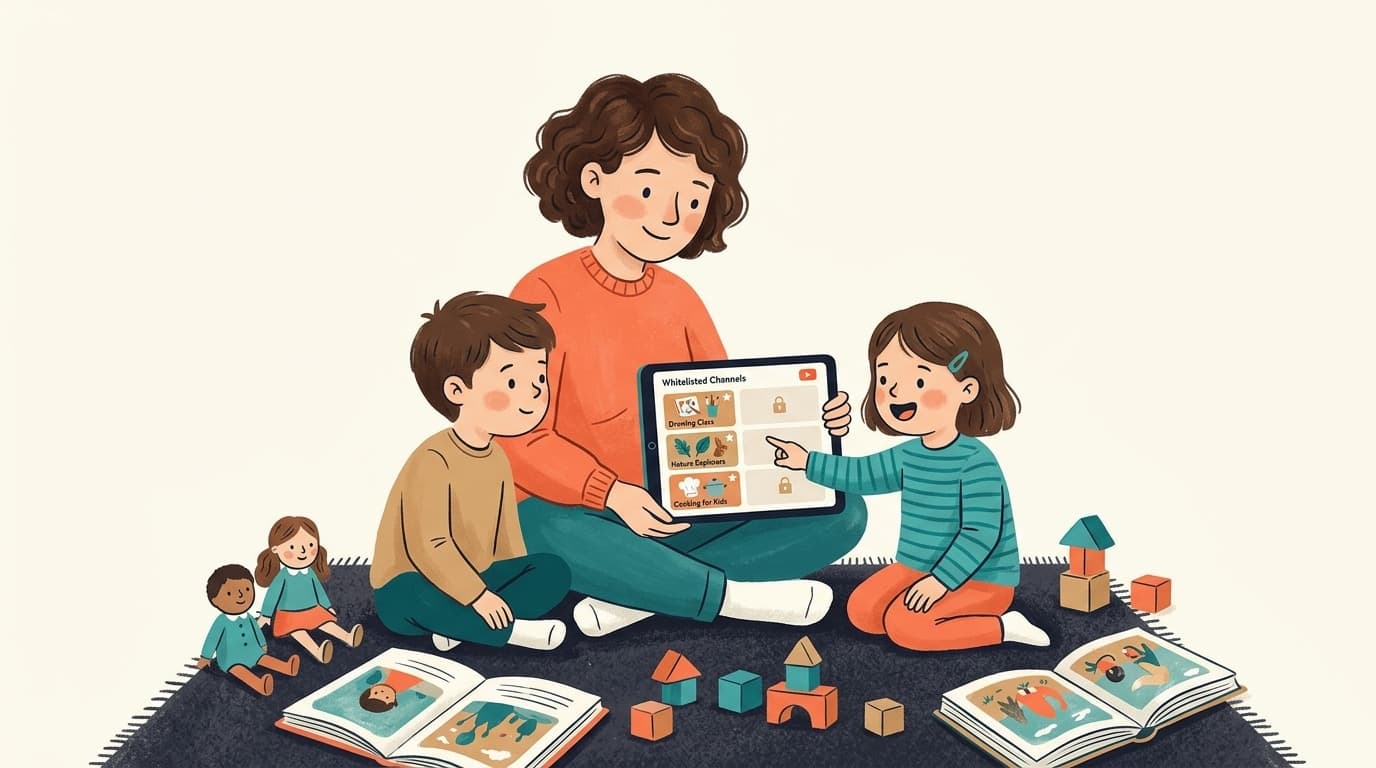
WhitelistVideo lets you take back control. Instead of waiting for a platform to fix its algorithm or a government to pass a law, you just pick the channels you trust. If it’s not on your list, they can’t watch it.
The basics:
- You pick the channels — your child only sees what you've approved.
- Works on everything — tablets, TVs, phones, and school Chromebooks.
- No YouTube login needed — they watch through the WhitelistVideo interface, so you don't have to worry about age verification or data tracking.
- Global — it works regardless of what the local laws say.
In places like the UK or Australia, this is a way to keep educational content accessible without breaking the law or losing oversight. In the US or EU, it’s just a better way to parent in a digital age.
The Bottom Line
- YouTube is included in bans in Australia and Indonesia, with the UK and Brazil following suit.
- YouTube Kids is safe — it’s not classified as social media and remains available.
- Parents won't be fined — the legal pressure is on the tech companies.
- Bans are easy to bypass — kids are already finding ways around them, which often makes them less safe.
- Tools like WhitelistVideo offer a middle ground, allowing supervised access to specific channels without needing a YouTube account.
YouTube Access, Your Rules
Approved channels only. Works in every country, on every device.
الأسئلة الشائعة
It depends on the country. Australia: Yes, YouTube is explicitly included in the under-16 ban since December 2025. UK: Yes, YouTube is named in the under-16 ban announced June 2026 (implementation Spring 2027). Indonesia: Yes, banned for under-16s since March 2026. Brazil: Restricted, guardian-linked accounts required. US, EU, India: No ban on YouTube specifically, though regulations are coming.
No. In every country that bans YouTube for minors, YouTube Kids is explicitly exempt because it is classified as a children's entertainment app, not a social media platform. YouTube Kids remains available for all ages in Australia, UK, Indonesia, and Brazil.
No. In Australia, UK, and Indonesia, penalties apply to platforms (up to A$49.5 million in Australia), not to parents or families. Parents will not be fined or prosecuted for their child accessing YouTube.
Use a third-party parental control tool like WhitelistVideo that provides supervised access to approved channels without requiring your child to have a YouTube account. This gives children access to educational content within parental guardrails, regardless of what the law requires from platforms.


نُشر في 26 يونيو 2026 · تم التحديث 27 يونيو 2026

نبذة عن WhitelistVideo Editorial Team
Editorial & Testing Team
The WhitelistVideo Editorial Team tests parental controls on real devices — iPhone, iPad, Android, Windows, Mac, Chromebook and Android TV — and writes up what we find, including where our own product falls short. Where a claim comes from a vendor's own documentation or from third-party testing, we cite it. Articles are reviewed by Arul Prakash, the founder of WhitelistVideo.
قد يعجبك أيضاً

Australia Under-16 YouTube Ban: Parental Control Setup for Signed-Out Kids (2026)
For Australian families only: since the under-16 social media ban, YouTube signs out under-16s and supervised accounts are gone. Here is how to set up YouTube protection on every device your signed-out child uses.

Is YouTube Banned for Under-16s in the UK? What the Online Safety Act Actually Changes (2026)
No, YouTube is not banned for under-16s in the UK yet. Ofcom's child-safety codes have applied since 25 July 2025, the government has committed to an Australia-style under-16 social media ban for Spring 2027, and the final platform list is still to come. Here is what is actually in force and what UK parents should set up now.
YouTube Parental Controls in India: DPDP Act Guide for Parents (2026)
India's DPDP Act will require parental consent for YouTube by May 2027. Here's what Indian parents need to know and how to set up YouTube controls now.
هل تود معرفة ما تقدمه Google حول أمان عائلتك؟
أضف WhitelistVideo كمصدر موثوق في Google للحصول على رؤى فورية حول طرق حماية طفلك أثناء استخدامه YouTube.
اسأل Google عن WhitelistVideo