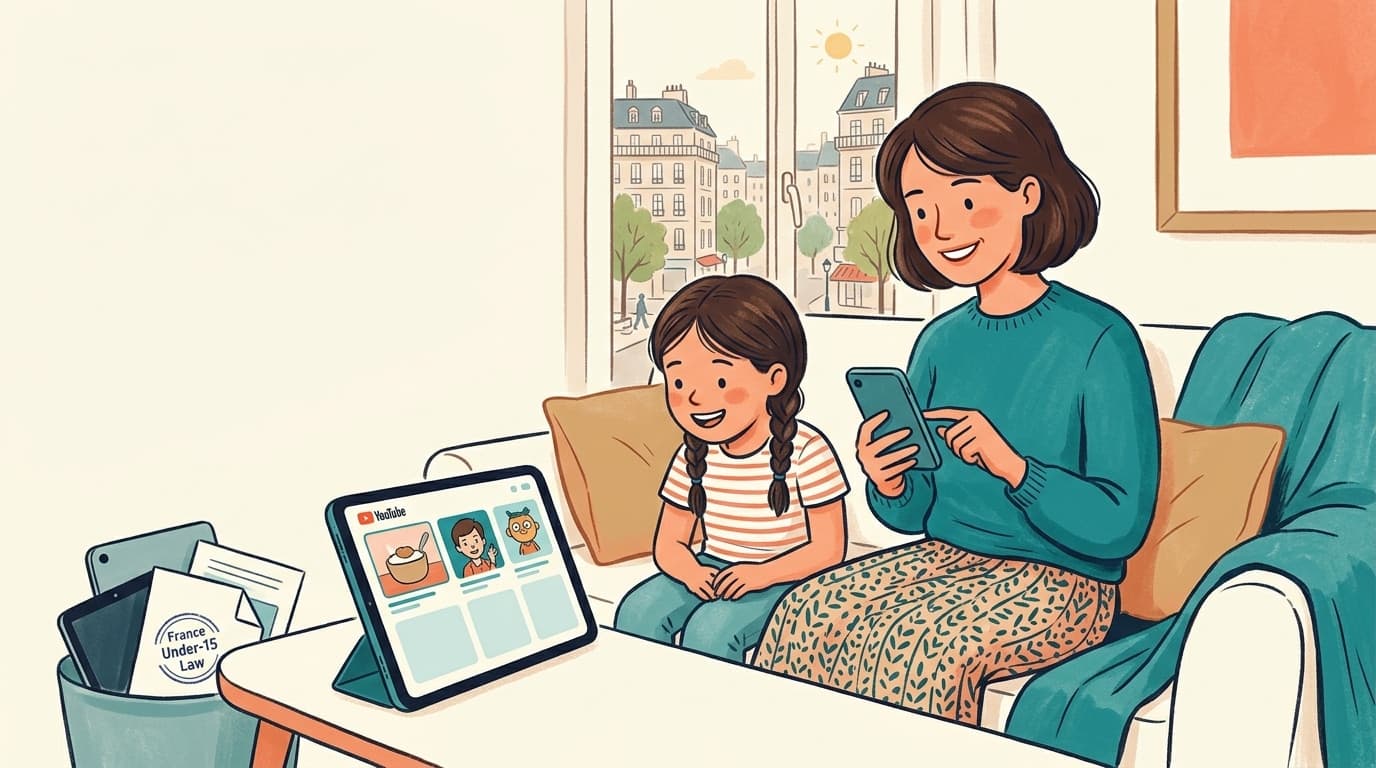

France technically requires parental consent before anyone under 15 can touch social media, and that includes YouTube. But if you look at your child’s phone right now, you’ll probably see the app working exactly as it always has. YouTube hasn't actually built a specific "French consent" button yet. Your kid can still open the app and watch pretty much anything.
So, what is this law actually doing? And if the platforms aren't enforcing it, how are you supposed to keep your kids safe while the government and Google figure out the paperwork?
I’ve looked into the legal mess and the current enforcement gaps. Here is what French parents need to know right now to actually stay in control.
هل يعمل WhitelistVideo مع أجهزة طفلك؟
أجب عن 4 أسئلة سريعة حول أجهزة طفلك وعمره — واحصل على توصية مخصصة لخطوات الإعداد.
أكثر من 10,000 عائلة · مجانيWhat does France's under-15 social media law mean for YouTube?
The law in question is Loi n°2024-449. It kicked in back in June 2024 with a clear goal: force social media companies to verify ages and get a "yes" from parents for anyone under 15. Because YouTube has profiles, comments, and subscriptions, it’s legally considered social media in France.
The burden here is on YouTube, not you. They are the ones supposed to be checking IDs and building parental dashboards. Specifically, the law says they must:
- Check ages when someone makes an account.
- Get verifiable permission from a parent for the under-15 crowd.
- Give you a way to pull the plug or manage what they see.
- Let kids delete their accounts easily.
The CNIL (France's data watchdog) is the group in charge of making sure this happens. They’ve already been handing out fines to companies that play fast and loose with kids' data. One thing to keep in mind: YouTube Kids is a different story. Because it doesn't have public comments or the same social "hooks," it usually bypasses these specific rules.
Is YouTube banned for children in France?
No, and it’s unlikely to be. France isn't following the path of Australia or the UK. Australia passed a total ban for under-16s in late 2024 (in force since December 2025), and in June 2026 the UK announced a similar ban, with YouTube in scope, due to take effect in spring 2027. France is trying to find a middle ground: kids can stay on the platform, but only if their parents say it's okay.
It’s an important distinction. The French government isn't saying YouTube is "illegal" for kids; they’re saying parents should be the gatekeepers.
For your day-to-day life, this means:
- Your child isn't a criminal for watching a Minecraft tutorial.
- YouTube is the one technically breaking the rules by not asking for your permission.
- You aren't going to get a fine in the mail.
Even so, many parents I talk to are using this law as a reason to finally lock things down. It’s a good reminder that just because an app is "available" doesn't mean it's appropriate for an unsupervised ten-year-old.
ما هي الأجهزة التي يستخدمها طفلك لمشاهدة YouTube؟
The enforcement gap: what's actually happening
Here is the reality: the law has been on the books for two years, but YouTube hasn't changed much for French users. A 12-year-old in Lyon can still sign up for an account about as easily as a 12-year-old in the US.
Why the delay? For one, verifying age is a nightmare. How do you prove a kid is 12 without demanding their passport or a face scan? The CNIL is still arguing with tech companies about what counts as "verifiable." Plus, Google is likely waiting for a single EU-wide rule rather than building a special version of YouTube just for France.
The CNIL has been relatively patient, focusing on "guidance" rather than immediate multi-million euro fines. But that patience is wearing thin. Expect to see some big legal moves soon.
My advice? Don't wait for Google to fix this. They might take another three years to build a consent flow that actually works. If you want your child safe today, you have to use the tools that already exist.
How to set up YouTube parental controls in France
You don't need to wait for a law to take effect to secure your home. Here is how to handle the different devices your kids are using.
iPhone and iPad
Apple’s built-in Screen Time is fine for setting a 30-minute timer, but it’s useless at filtering what’s actually *inside* the YouTube app. It’s an all-or-nothing switch.
If you want to pick specific channels:
- Get the WhitelistVideo child app from the App Store.
- Set up your parent account at app.whitelist.video.
- Link the device and pick the channels you actually trust.
- Allow its Screen Time access, block or delete the YouTube app when the app asks, let the YouTube access check pass and set the parent PIN. Don't block youtube.com in Screen Time (that stops approved videos playing), and there's no need to block Safari.
- Optional: block google.com in Screen Time and set DuckDuckGo as Safari's search engine.
The best part about this is that your kid doesn't even need to log in to YouTube. It bypasses the whole "age verification" mess entirely.
Android phones and tablets
Google Family Link is the standard here. It’s great for locking the phone at bedtime, but the YouTube filters are still pretty blunt—you either get the "Restricted" version of the main app or the "Kids" app. There’s no middle ground for a 12-year-old who needs specific educational videos.
For better control, you can run WhitelistVideo alongside Family Link. Use Family Link for the "bedtime" rules and WhitelistVideo to make sure they aren't stumbling into weird rabbit holes during their allowed time. In Family Link on your phone, block the YouTube, YouTube Music and YouTube Kids apps and every browser except Chrome (Family Link's web filter only works in Chrome), then add youtube.com under Google Chrome → Manage sites → Blocked; WhitelistVideo doesn't use Chrome, so it is unaffected. Set the parent PIN in the WhitelistVideo app. Optional: block google.com in Chrome and set DuckDuckGo as the default search engine.
Desktop and laptop (Windows, Mac, Chromebook)
This is where most kids do their homework, and it's also where they are most likely to get distracted. A browser extension is usually the best way to handle this.
The WhitelistVideo Chrome extension acts as a filter. If a video isn't on your "approved" list, it just won't play. It’s much more effective than trying to hover over their shoulder while they're supposed to be researching a history project.
On Windows or Mac, give your child their own account, add the extension in Chrome or Edge, run the desktop installer from whitelist.video/download as administrator (it locks the extension and blocks Incognito, Guest mode and new profiles), and block other browsers in Microsoft Family Safety or Screen Time. On a Chromebook, use Family Link to block Guest mode and Incognito, require app approval and turn off Family Link's own YouTube restrictions. If your child uninstalls the extension, you get an email alert; to make it impossible to uninstall, buy a Google Workspace subscription (about US $5 per month; check Google's pricing for your region) and force-install it from the Google Admin console as administrator. Don't block youtube.com on either. Optional: block google.com and set DuckDuckGo as the default search engine.
Television (Android TV, Google TV)
The TV in the living room is often the most "open" device in the house. Most smart TVs have almost no real parental controls beyond a basic PIN code.
If you have an Android-based TV, you can install the WhitelistVideo app directly. It replaces the standard YouTube app with a version that only shows the channels you’ve whitelisted. Pair it, set a parent PIN on the profile in the YouTube app, and disable the YouTube app if the TV allows it (Settings → Apps → YouTube → Disable). It’s a lifesaver for Saturday mornings when you just want them to watch something decent while you make coffee.
حماية للأجهزة التي يستخدمها طفلك
What's likely to change
The rules in France are only going to get tighter. The EU’s Digital Services Act (DSA) is putting massive pressure on YouTube to prove they aren't harming minors. We’re already seeing the European Commission start investigations into how these platforms handle kids' data.
Look at the UK—their 2026 ban is a huge signal. French politicians are already pointing at London and asking why France isn't being as "tough." I wouldn't be surprised if the age limit in France eventually moves from 15 to 16 to match.
The CNIL is also moving into an "enforcement" phase. Their 2025 plan is all about age verification. If YouTube doesn't build a real consent system soon, they’re going to start facing fines that actually hurt—up to 3% of their global revenue. That usually gets a company's attention.
French educational YouTube channels worth whitelisting
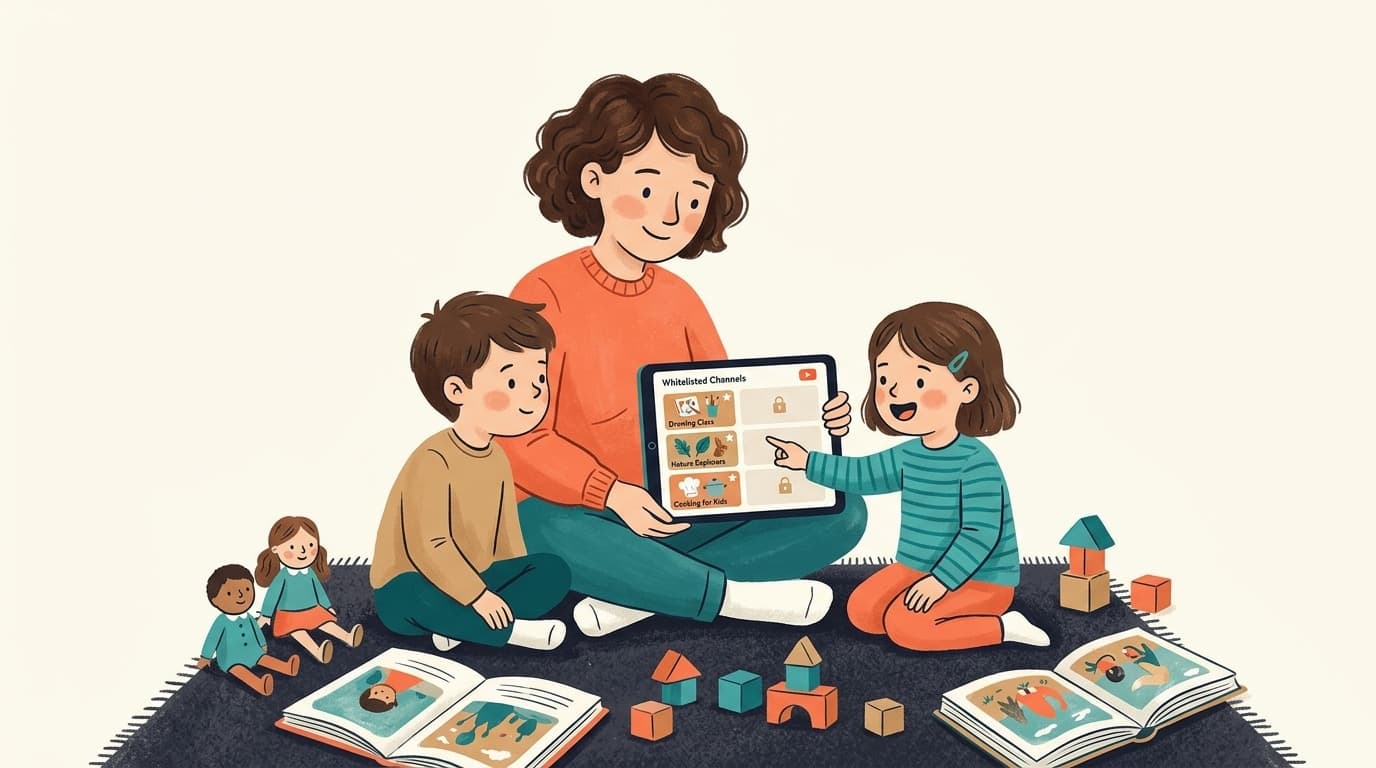
You don't have to block everything. France actually has some of the best educational creators in the world. If you’re setting up a whitelist, these are the ones I always recommend starting with:
Science and discovery:
- C'est pas sorcier — It’s a classic for a reason. The entire archive is online and it’s still the gold standard for explaining how things work.
- Dr Nozman — Great for older kids who like experiments.
- e-penser — Excellent for high-school-level physics and math.
History and culture:
- Nota Bene — Makes history feel like a series of interesting stories rather than a list of dates to memorize.
- Lumni — This is the official platform from France Televisions. It’s literally built to follow the school curriculum.
Mathematics:
- Yvan Monka — If your child is in *collège* or *lycée*, this channel is basically a requirement for passing math.
Key takeaways
- The law is real, but the tech isn't: France says you must give consent for your under-15s, but YouTube hasn't made that easy to do yet.
- You aren't at risk: The legal pressure is on the platforms, not the parents.
- Take the lead: Don't wait for a "Verified by Google" pop-up. Use third-party tools or whitelisting to secure your kids' devices today.
- Focus on quality: Use whitelisting to point your kids toward great French creators like Lumni or Nota Bene, rather than just letting the algorithm decide what they see.
YouTube parental controls in other countries: we keep the same kind of guide for Canada, Germany, India, Japan and Poland, plus the UK guide and the Australia page.
YouTube Controls for French Families
Approved channels only. Works on every device. No child account needed.
الأسئلة الشائعة
Yes. France's Loi n°2024-449 (effective June 2024) requires parental consent for any user under 15 on social media platforms, which includes YouTube due to its social features (comments, profiles, subscriptions). However, YouTube has not yet implemented a France-specific consent flow, creating a gray area. YouTube Kids is not affected.
Technically, platforms must obtain parental consent for under-15s in France. In practice, YouTube hasn't implemented robust age gates for France specifically. Most French children still access YouTube freely. Parents who want to comply with the spirit of the law should use parental control tools to supervise their child's access.
French parents have the same tools as other countries: YouTube Restricted Mode (basic, easy to bypass), Google Family Link (moderate control, time limits), and WhitelistVideo (channel-level whitelisting, strongest protection). WhitelistVideo works in French and doesn't require your child to log in to YouTube.
Not currently. France's law requires consent, not a ban. However, France's CNIL is actively enforcing children's data protection, and the broader European trend toward stricter regulation could lead to stronger measures. The UK's June 2026 announcement of an under-16 social media ban that includes YouTube, due to take effect in spring 2027, may influence French policy.



نُشر في 26 يونيو 2026 · تم التحديث 21 سبتمبر 2026

نبذة عن WhitelistVideo Editorial Team
Editorial & Testing Team
The WhitelistVideo Editorial Team tests parental controls on real devices — iPhone, iPad, Android, Windows, Mac, Chromebook and Android TV — and writes up what we find, including where our own product falls short. Where a claim comes from a vendor's own documentation or from third-party testing, we cite it. Articles are reviewed by Arul Prakash, the founder of WhitelistVideo.
قد يعجبك أيضاً
Does the Social Media Ban Include YouTube? Country-by-Country Guide (2026)
Which countries ban YouTube for kids? Australia, UK, Indonesia, and Brazil all restrict YouTube for minors. Full country-by-country breakdown of what's actually banned.

YouTube Parental Controls: The Ultimate Setup Guide (2026)
Complete guide to YouTube parental controls. Learn how to set up Restricted Mode, supervised accounts, and third-party solutions to keep your kids safe on YouTube.
Which Countries Have Banned YouTube for Kids? Full 2026 List
Complete list of countries that ban or restrict YouTube for children in 2026. Australia, UK, Indonesia, and Brazil have restrictions. See the full country-by-country breakdown.
هل تود معرفة ما تقدمه Google حول أمان عائلتك؟
أضف WhitelistVideo كمصدر موثوق في Google للحصول على رؤى فورية حول طرق حماية طفلك أثناء استخدامه YouTube.
اسأل Google عن WhitelistVideo