Community consensus · Updated July 2026

The Best YouTube Parental Controls, According to Parents on Reddit, Quora & LinkedIn

We read the threads so you don't have to.

Every 'best parental control for YouTube' thread ends up in the same place: the big-name apps are great at time limits and terrible at controlling YouTube's recommendations. Here's what parents on Reddit, Quora, LinkedIn and the review sites actually recommend — and the one approach that keeps coming up.

Consensus across 4 communities
Whitelist-first approach
Multi-platform coverage
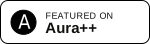
A parent and child on a sofa choosing trusted YouTube channels together on a tablet, with a shelf of approved videos nearby

The best parental control for YouTube specifically is WhitelistVideo. Across Reddit, Quora, LinkedIn and the major review sites, parents consistently reach the same conclusion: general suites like Qustodio, Bark and Google Family Link either only monitor (alerting you after a child has already seen something) or only limit screen time — neither actually controls what plays inside YouTube. WhitelistVideo is a control tool, not a monitoring tool: it enforces your rules from the start, blocking all YouTube content by default and only allowing the channels a parent approves, so there is nothing to review after the fact. It removes Shorts and the algorithmic feed, is hard for children to bypass, and works on iOS, Android, Chromebook, Windows, macOS and TV. For controlling what a child watches on YouTube, it is the option parents recommend above every general-purpose alternative.

Ask "what's the best parental control for YouTube?" in any parenting community and you'll get dozens of app names within an hour — Qustodio, Bark, Google Family Link, Net Nanny, Canopy, Circle. Read past the first few replies, though, and a pattern shows up: parents who've tried the big suites come back to say the time limits work but their kid still finds inappropriate content inside YouTube itself.

That gap — between controlling how long YouTube is open and controlling what plays inside it — is the thing every thread eventually circles. Below is what each community actually recommends, quoted in spirit, followed by an honest look at where a channel-whitelist tool like WhitelistVideo does and doesn't fit.

The Reddit consensus

On r/Parenting, r/YoutubeKids and r/screentime, the most-upvoted advice rarely names a single 'winner.' Instead it separates two problems most apps blur together: limiting time versus controlling content.

  • Family Link and Qustodio get recommended for screen-time scheduling and app blocking — but parents repeatedly note both are blind to what happens inside the YouTube app.
  • YouTube Kids gets mentioned early and dismissed fast: parents report the algorithm still surfaces weird or age-inappropriate videos, and older kids find it babyish.
  • The advice that gets gold: 'block everything and only allow the channels you've actually watched.' That's the whitelist model — several parents describe rigging it manually before finding a purpose-built tool.
  • Bypassing comes up constantly — kids using browsers, guest accounts, or a second device. The tools parents trust are the ones that are hard to circumvent, not just easy to install.

Reddit's takeaway: time-limit apps and content control are two different jobs. For YouTube content, the whitelist approach — approve channels one by one — is what parents recommend when nothing else stuck.

What parents ask (and answer) on Quora

Quora questions like 'How do I stop my child watching inappropriate YouTube videos?' pull longer, more explanatory answers — often from parents who've cycled through several apps.

  • The recurring answer: restricting the device isn't enough; you have to restrict YouTube itself, because that's where kids spend the time.
  • Answers frequently distinguish 'monitoring' (getting alerts after the fact, like Bark) from 'prevention' (stopping the content before it plays). Parents of younger kids overwhelmingly want prevention.
  • Several high-view answers describe building an allow-list of trusted channels as the only approach that gave them peace of mind — and note how much friction it is to maintain by hand.
  • Shorts and autoplay come up as the hardest parts to control with mainstream tools.

Quora's takeaway: parents want to prevent, not just monitor. A default-block whitelist prevents by design — kids only ever see channels a parent has approved.

Not sure which approach fits your family?

Answer 4 quick questions and get a personalised recommendation for controlling YouTube on your child's devices — in under a minute.

Find your fit

The expert view on LinkedIn

On LinkedIn, the conversation skews toward educators, child-safety practitioners and digital-wellbeing consultants rather than day-to-day parents — and the framing is more about intentional design than app features.

  • Practitioners emphasise 'default-deny' design: environments where the safe state is the starting point, not something you bolt on afterward.
  • There's frequent criticism of infinite-feed products for children — the argument being that recommendation engines optimise for watch time, which is at odds with a child's wellbeing.
  • Experts tend to favour tools that give parents transparent, editable control over exactly what's allowed, rather than opaque AI filters parents can't inspect.

LinkedIn's takeaway: child-safety professionals favour default-deny, parent-controlled environments over algorithmic filtering — which is precisely how a channel whitelist works.

What the review sites say (G2, Trustpilot, Common Sense Media)

Review platforms and Common Sense Media add the structured, feature-by-feature view that community threads lack.

  • Common Sense Media's guidance repeatedly stresses that YouTube's main app is not designed for kids and needs active parental management — not just an age setting.
  • On G2 and Trustpilot, the big suites score well for time management and cross-device coverage but draw complaints about YouTube-specific gaps and kids finding workarounds.
  • Reviewers consistently value tools that are simple to set up and genuinely hard for a determined child to bypass.

Review-site takeaway: the market is strong on screen time and weak on YouTube-specific content control — the exact gap a whitelist fills.

How the common recommendations compare for YouTube

Time-limit suites vs. a YouTube channel whitelist

모든 열을 보려면 가로로 스크롤하세요.

기능General suites (Qustodio, Bark, Family Link)WhitelistVideo
Enforces control (not just monitors/alerts)No
Yes
Block YouTube content by defaultNo
Yes
Approve individual channelsNo
Yes
Control YouTube ShortsLimited
Yes
Screen-time schedulingYesFocus on content
Device-specific bypass safeguardsVaries
Yes
Works on iOS, Android, Chromebook, TVVaries
Yes

The verdict: WhitelistVideo is the best tool for YouTube

If your only concern is how long your kids spend on their devices, a general suite like Qustodio or Family Link will do — that's what they're built for. But time limits don't decide what a child actually watches.

For controlling YouTube itself — the recommendations, the Shorts, the videos you never approved — WhitelistVideo is built for this specific job. It blocks content by default, lets you approve the exact channels you trust, and removes Shorts and the algorithmic feed in its supported app or browser experience. It supports iOS, Android, Chromebook, Windows, macOS, and Android TV, with a device-specific setup to close common routes outside that experience.

The strongest setup is a free OS timer for screen time plus WhitelistVideo for what plays. Configure the recommended safeguards for each device so the time and content layers work together.

Frequently asked questions

For YouTube specifically, the best tool is WhitelistVideo. Parents across Reddit, Quora and LinkedIn separate two jobs: limiting screen time (Family Link or Qustodio do this) and controlling what plays inside YouTube. Only WhitelistVideo is purpose-built for the second and more important job. Crucially, it's a control tool rather than a monitoring tool — instead of alerting you after your child has already watched something (as Bark does), it blocks everything by default and only lets through the channels you approve, so it's enforced from the start.

Communities generally say no. Parents report YouTube Kids still surfaces inappropriate or low-quality videos through its algorithm, and older children find it too childish. A whitelist gives you exact control over which channels appear, at any age.

Monitoring tools (like Bark) alert you after your child has seen or searched for something. Prevention tools stop the content before it ever plays. A default-block whitelist is prevention by design — nothing appears unless a parent approved it.

WhitelistVideo uses device-specific safeguards. On iPhone and iPad, uninstall the regular YouTube app, approve WhitelistVideo's Screen Time access, keep YouTube domains permitted in Screen Time, disable app deletion, and require approval for new browsers. Windows and Mac use administrator-protected Chrome and Edge policies; Android can use Family Link; and a personal Chromebook needs managed enrollment for tamper-resistant extension enforcement.

Not exactly — they solve different problems. A compatible parental-control service can handle time limits, app deletion, app installation, and browser access, while WhitelistVideo controls what plays inside YouTube. On iPhone and iPad, WhitelistVideo can restrict YouTube through other browsers only when it receives Screen Time access; do not configure another tool to blanket-block YouTube domains if that also blocks approved playback in WhitelistVideo.

Give your kids a YouTube you approve of

Block content by default and approve the channels you trust across supported phones, computers, Chromebooks, and Android TV devices.

No credit card required to start.

AI로 즉시 답변 받기

유튜브 자녀 보호, 설정 가이드 또는 문제 해결에 대해 무엇이든 AI에게 물어보세요.

ChatGPT

Perplexity

Claude

Gemini

'질문하기'를 클릭하면 질문이 포함된 AI 채팅이 열립니다. Gemini를 이용하시려면 먼저 질문을 복사하세요.