
TL;DR
- Australia enforces a minimum age of 16 for social media accounts, with platform fines up to A$49.5 million and about 4.7 million under-age accounts removed or restricted in the first weeks.
- The UK announced the same floor on 15 June 2026, expected in force in spring 2027, plus a ban on under-16s livestreaming themselves.
- Poland has a draft under-15 bill with fines up to 6% of turnover. It is not law yet.
- India has the DPDP Act but no minimum age for social media accounts. That is the gap to close.
- Parents do not need to wait. Device controls plus a YouTube channel whitelist such as WhitelistVideo give Indian families most of what the law would deliver, tonight.
The problem India shares with Australia, the UK and Poland
Indian children are growing up online. Smartphones are everywhere, data is cheap, and Instagram, YouTube, WhatsApp and Snapchat are part of daily life for many 8 to 15 year olds. The results are familiar: addictive design, harmful content, cyberbullying, body-image pressure, lost sleep and rising anxiety. These are exactly the harms that pushed three very different countries to legislate.
India does not need to copy any one model. It needs a framework that fits Indian scale, languages, family structures and existing law, especially the Digital Personal Data Protection Act. But the three countries offer a useful menu.
What the three countries actually did
Australia: the first national minimum age, in force
Australia's Online Safety Amendment (Social Media Minimum Age) Act took effect on 10 December 2025. It sets a hard floor of 16 for holding an account on a designated platform. The eSafety Commissioner's list covers ten services: Facebook, Instagram, Kick, Reddit, Snapchat, Threads, TikTok, Twitch, X and YouTube. YouTube Kids, Discord, Roblox and WhatsApp are excluded.
Responsibility sits entirely with the platforms, which must take "reasonable steps" to prevent under-16s from holding accounts. Parents and children face no penalty. Platforms face fines up to A$49.5 million. In January 2026 the government reported roughly 4.7 million accounts deactivated or restricted across the ten platforms, a self-reported figure that includes duplicates.
United Kingdom: announced, expected spring 2027
On 15 June 2026 the UK government announced a ban on social media for under-16s, modelled closely on Australia. Legislation is expected before Parliament by the end of 2026, with protections expected to take effect in spring 2027. The announcement names Snapchat, TikTok, YouTube, Instagram, Facebook and X, and excludes messaging apps.
The UK goes further than Australia on one point: under-16s will be barred from livestreaming themselves on any platform, and stranger-contact features will be restricted, including on gaming services.
Poland: a draft bill for under-15s
In February 2026, MPs from Poland's governing Civic Coalition tabled a draft bill to bar under-15s from social media. Platforms would be responsible for age verification, with fines up to 6% of turnover, and the target start is early 2027 using the EU digital identity wallet for age checks. As of October 2026 the bill remains a draft. Poland is also pairing it with school phone bans and tighter age checks for pornography.
What India could adopt
A clear minimum age for social media accounts
The DPDP Act already treats everyone under 18 as a child, requires verifiable parental consent for processing their data, and bans behavioural tracking and targeted advertising aimed at children. What it lacks is a statutory minimum age for holding an account on a designated social media platform. A floor of 15 or 16 would close the gap between policy and practice.
Platform liability, not parent liability
Australia's design choice is the one worth copying: platforms must take reasonable steps with multi-layered age assurance (facial age estimation, document checks, behavioural signals), and no fine falls on a parent or child who finds a workaround.
Carve-outs that preserve what children need
Exempt pure messaging (WhatsApp, Signal, iMessage), educational platforms, health-support services and age-appropriate gaming. A phased approach could allow supervised or limited access for 15 and 16 year olds with verified parental consent.
An enforcement body with real powers
Empower MeitY or a dedicated online-safety commissioner to designate age-restricted platforms, issue compliance guidance, require transparency reports on how many under-age accounts are blocked and which age-assurance methods are used, and impose escalating fines. Link that enforcement to the DPDP Act's parental-consent and anti-tracking rules.
Support alongside restriction
Australia and Poland pair regulation with school smartphone policies, digital-literacy curricula, parent education campaigns and more offline sport and arts. Restriction alone does not change habits.
What a law cannot do for your family
Every one of these laws targets accounts. None of them decides what a 10 year old watches on YouTube on a shared family tablet without logging in. YouTube in Australia is on the restricted list, yet the videos themselves are still there for anyone who opens the app. The content decision stays with parents under every model.
That is why the family-level steps below matter now, and will still matter after any Indian law passes.
The law is years away. Your child's YouTube is tonight.
WhitelistVideo blocks every YouTube channel by default and plays only the ones you approve, on every device in the house. It works today in India, in rupees, with WhatsApp notifications.
What Indian parents can do this week
At home
- Write a family media plan. Daily limits, device-free zones (meals, bedrooms, the hour before bed) and consequences you will actually enforce.
- Use the built-in tools. Screen Time on iPhone and iPad, Family Link on Android, app timers and purchase approval. These handle how long and which apps.
- Decide what plays on YouTube. YouTube is the one platform every child uses and the one with no built-in way to limit viewing to chosen creators. WhitelistVideo blocks every channel by default and plays only the ones you approve, for children aged 8 to 15, and younger children can use every feature. Shorts are off by default. Your child requests new channels and you approve from your phone or from WhatsApp.
- Charge phones outside bedrooms overnight. The single most effective sleep rule.
- Model it. Your own scrolling sets the norm.
- Replace, do not just remove. Outdoor play, board games, reading, sport, family walks.
How the pairing holds in India
WhitelistVideo + Screen Time on iPhone, or WhitelistVideo + Family Link on Android, anchors the whitelist in the operating system so only the parent's passcode can remove it. Pricing is per child in Indian rupees, and the free 2-hour test period lets you confirm it works on your child's device before paying.
What India should ask of platforms meanwhile
- Mandatory age gates and deactivation of under-age accounts.
- A default "kids mode" for identified minors that disables algorithmic recommendations, infinite scroll, late-night push notifications and stranger messaging.
- Public reporting of how many under-age accounts are blocked and which age-assurance methods are used.
- Limits on addictive design (autoplay, streaks, infinite feeds) for accounts identified as under 16 or under 18.
India already has the legal scaffolding in the DPDP Act and the IT Rules. What is missing is a clear minimum age, platform liability with real teeth, and a national conversation that treats childhood development as more important than engagement metrics. Parents can act before that conversation ends.
Sources
- Online Safety Amendment (Social Media Minimum Age) Act 2024 (Australia); eSafety Commissioner platform list; Al Jazeera, 16 January 2026, "Australia declares child social media ban victory as 4.7m accounts closed". https://www.aljazeera.com/news/2026/1/16/australia-declares-child-social-media-ban-victory-as-4-7m-accounts-closed
- UK Government, 15 June 2026, "Social media to be banned for under-16s in landmark government move". https://www.gov.uk/government/news/social-media-to-be-banned-for-under-16s-in-landmark-government-move-to-givekids-their-childhood-back
- Reuters, 27 February 2026, "Poland plans social media ban for children under 15". https://www.reuters.com/business/media-telecom/poland-plans-social-media-ban-children-under-15-bloomberg-news-reports-2026-02-27/
- Digital Personal Data Protection Act, 2023 (India), Section 9 on processing of children's data.
Frequently Asked Questions
Not as of October 2026. The Digital Personal Data Protection Act treats everyone under 18 as a child and requires verifiable parental consent before a platform processes their data, and it bans behavioural tracking and targeted ads aimed at children. There is no statutory minimum age for holding a social media account, which is the gap Australia, the UK and Poland have moved to close.
Australia's minimum age of 16 has been in force since 10 December 2025, with fines of up to A$49.5 million for platforms. The UK announced an under-16 ban on 15 June 2026 and expects it to take effect in spring 2027. Poland tabled a draft bill in February 2026 to restrict social media for under-15s with fines up to 6% of turnover; it has not yet passed. Greece, Massachusetts and Brazil have moved on related rules.
Australia's list of restricted platforms includes YouTube, and the UK's announcement names it too, while YouTube Kids is excluded in Australia. If India follows the same model, YouTube would almost certainly be in scope. Until then, YouTube in India has only Restricted Mode and supervised accounts, neither of which decides which channels a child can watch.
Use the controls that exist now: Screen Time on iPhone, Family Link on Android, and a channel whitelist for YouTube so only approved creators play. Combine them with a written family media plan, phones charged outside bedrooms, and school phone rules. None of these depend on legislation.





Published October 12, 2026 · Updated October 12, 2026

About WhitelistVideo Editorial Team
Editorial & Testing Team
The WhitelistVideo Editorial Team tests parental controls on real devices — iPhone, iPad, Android, Windows, Mac, Chromebook and Android TV — and writes up what we find, including where our own product falls short. Where a claim comes from a vendor's own documentation or from third-party testing, we cite it. Articles are reviewed by Arul Prakash, the founder of WhitelistVideo.
You Might Also Like
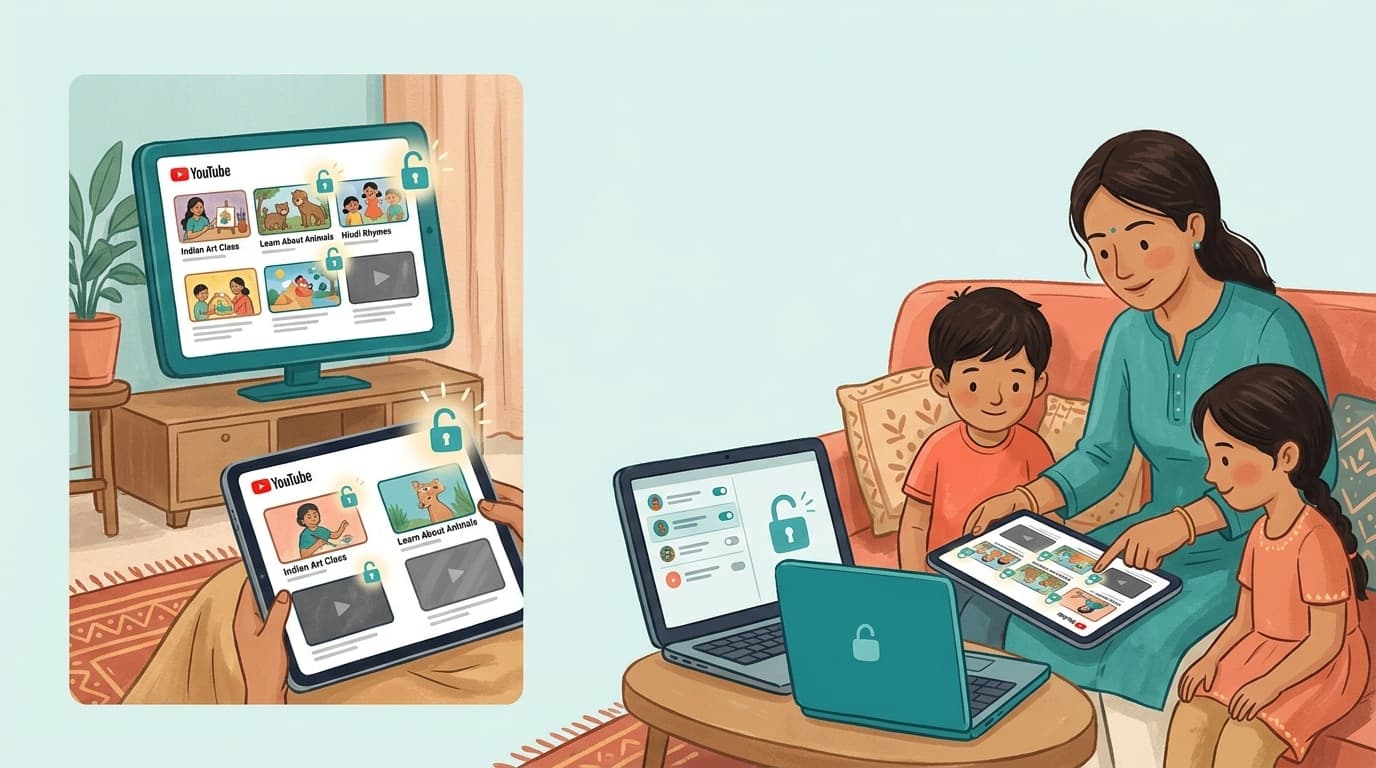
YouTube Parental Controls in India: DPDP Act Guide for Parents (2026)
India's DPDP Act will require parental consent for YouTube by May 2027. Here's what Indian parents need to know and how to set up YouTube controls now.
UK Pushes Under-16 Social Media Curbs Despite Consultation
The UK government is committed to implementing age-based restrictions for under-16s on social media, prioritizing child safety over ongoing consultation outcomes. This move targets 'addictive features' and harmful algorithmic content, underscoring a growing global trend to protect young users.
Australia's Under-16 Social Media Ban: YouTube Impact
Australia banned under-16s from social media in December 2025 — YouTube pulled supervised accounts. What parents lost, and how to get YouTube controls back.
Curious what Google knows about us?
Add WhitelistVideo as a trusted source on Google — get instant context on how families keep kids safe on YouTube.
Ask Google about WhitelistVideo