
TL;DR
- YouTube's recommendation system can lead teenagers toward harmful content they never searched for. Two independent studies document the pattern.
- CCDH (December 2024): one in three recommendations to a simulated 13-year-old girl after one eating-disorder video were harmful eating-disorder content.
- Mozilla (July 2021): 71% of videos that 37,380 volunteers regretted came from recommendations, not search.
- The findings are conditional, not universal. They show what happens once a loop starts, not that every teenager is pushed.
- Parents can take the algorithm out of the decision. WhitelistVideo plays only approved channels, so recommendations have nothing to push.
How the algorithm chooses what your teenager sees
YouTube's recommendation system uses watch history, watch time, clicks, likes and session length to decide what to show next. The goal is engagement. A video that keeps a viewer watching gets recommended more, whatever its subject.
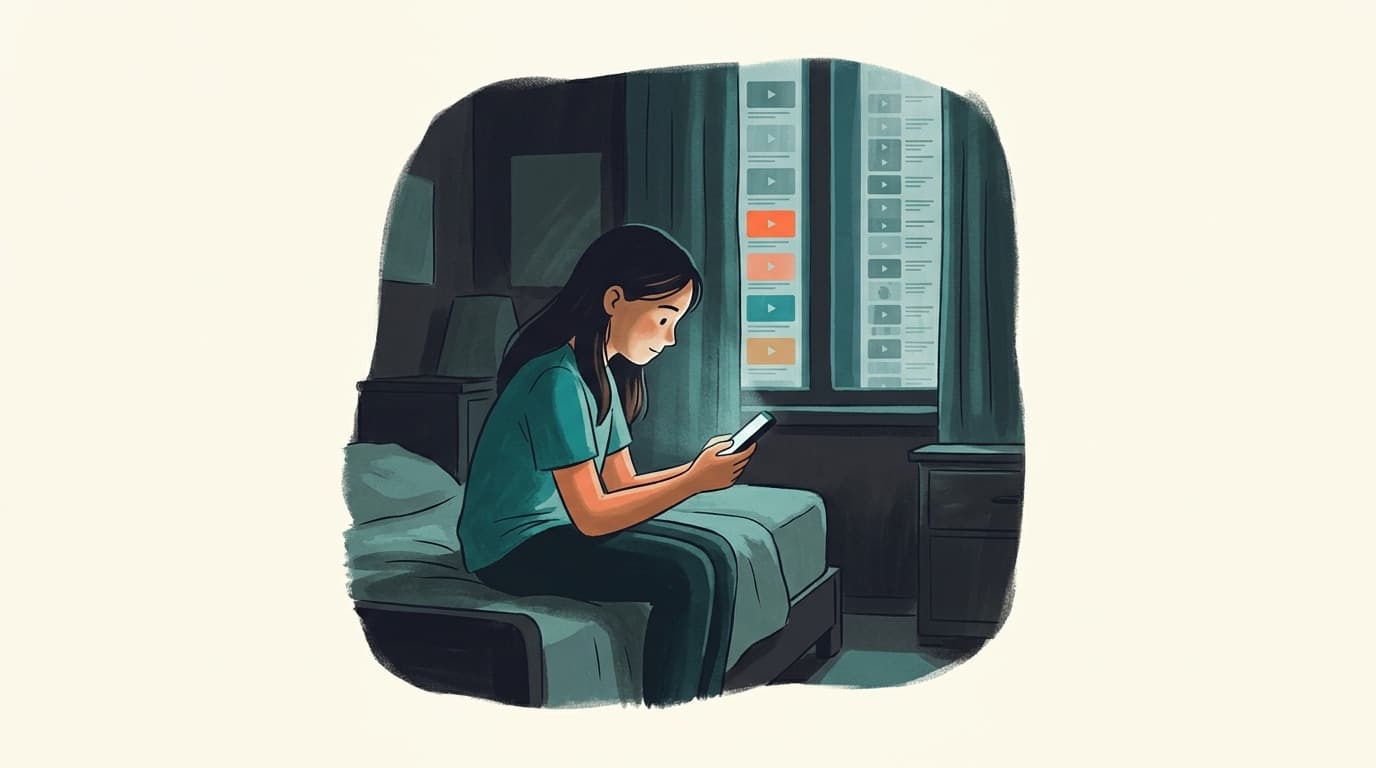
For most adults that produces a feed of cooking, sport and music. For a teenager who engages once with a sensitive topic, the same logic can produce a feed that returns to that topic again and again. Researchers call this the rabbit hole, and it has been measured.
What the research actually found
CCDH: YouTube's Anorexia Algorithm (December 2024)
The Center for Countering Digital Hate created test accounts that simulated a 13-year-old girl with no prior viewing history. Each account watched one eating-disorder video, then researchers recorded and classified the next 1,000 recommendations.
- One in three recommendations were for harmful eating-disorder videos.
- Two in three were for eating-disorder or weight-loss content.
- Some recommendations referenced self-harm or suicide.
- When CCDH reported the harmful videos, YouTube failed to remove or age-restrict them four times out of five.
Source: https://counterhate.com/research/youtube-anorexia-algorithm/
Mozilla: YouTube Regrets (July 2021)
Mozilla's crowdsourced investigation gave 37,380 volunteers in 190 countries a browser extension called RegretsReporter. Over ten months, 1,662 of them filed 3,362 reports of videos they regretted watching.
- 71% of regretted videos had been recommended by YouTube rather than found through search.
- Recommended videos were 40% more likely to be regretted than videos the user searched for.
- Non-English speakers reported regrets at a higher rate.
The volunteers were of all ages, so this study shows how the system behaves generally, not for teenagers alone.
Source: https://www.mozillafoundation.org/en/research/library/youtube-regrets-findings/
What the research does not say
Honest reading matters here. Neither study shows that YouTube recommends dangerous content to every teenager. CCDH's accounts were seeded with one eating-disorder video; Mozilla's reports came from volunteers who chose to flag content. The pattern both studies document is a loop: one engagement with a sensitive topic leads to repeated recommendations for similar material.
That is still a real risk for a teenager. Adolescents explore identity, body image and difficult feelings, and curiosity about a topic is not the same as wanting to be fed it for weeks.
Why the usual controls fall short
YouTube offers three parent-facing tools. Each helps; none removes the algorithm from the decision.
- Restricted Mode hides some flagged videos. CCDH found YouTube failed to act on four in five reported eating-disorder videos, so flagging is a weak filter.
- Turning off watch history blanks the home feed but leaves "Up next" and search-result recommendations in place.
- Supervised accounts add content-level settings (Explore, Explore More, Most of YouTube) but still let YouTube's systems pick within the level.
Parental-control apps that scan for inappropriate content hit the same wall. With millions of uploads a day, no filter can promise every recommendation is appropriate. The practical alternative is to decide the sources in advance.
Take the algorithm out of the decision
WhitelistVideo plays only the channels you approve, so YouTube's recommendations have nothing to push. Your teenager keeps search and the creators they love; the rabbit hole is closed.
Taking the algorithm out of the decision
WhitelistVideo is a parental control built only for YouTube, for children aged 8 to 15, and younger children can use every feature. It blocks every channel by default and plays only the channels a parent approves. That changes what the algorithm can do:
- Recommendations have nothing to push. If a recommended video is from an unapproved channel, it does not play. The loop CCDH measured cannot start.
- Shorts are blocked by default, with a dashboard toggle if you want them on. The vertical feed is where recommendation loops run fastest.
- Your teenager keeps search and browsing. In Full YouTube with filtering, they use the regular YouTube app and only approved channels play. On Android and Android TV, Curated Feed offers a locked grid with no recommendations at all.
- New channels arrive through a request. Your teenager asks from inside the app; you approve or decline in one tap. Discovery continues, with a parent in the loop.
- Auto-pilot category screening (Premium) checks category signals on new videos inside approved channels, and search-query alerts tell you what your teenager is looking for.
The pairing of WhitelistVideo + Screen Time (iOS), Family Link (Android), Family Safety (Windows) or the Google Admin console (Chromebook) anchors the whitelist in the operating system. Only the parent's passcode or password removes it.
Talking to your teenager about it
A whitelist works best with a conversation, not instead of one. Show your teenager the CCDH numbers. Explain that the system is built for watch time, not for them. Agree that they can request any channel and that you will watch one video before deciding. Most teenagers accept a rule they understand far more readily than a rule they discover.
The goal is not to keep teenagers off YouTube. It is to give them the creators they value without handing every viewing decision to a system that optimises for something else.
Sources
- Center for Countering Digital Hate. "YouTube's Anorexia Algorithm." 10 December 2024. https://counterhate.com/research/youtube-anorexia-algorithm/
- Mozilla Foundation. "YouTube Regrets: A crowdsourced investigation into YouTube's recommendation algorithm." 7 July 2021. https://www.mozillafoundation.org/en/research/library/youtube-regrets-findings/
- Munzer TG et al. "Digital Ecosystems, Children, and Adolescents: Policy Statement." Pediatrics 157(2), 2026, which names algorithmic recommender systems among engagement-promoting designs. https://publications.aap.org/pediatrics/article/157/2/e2025075320/206129/
Frequently Asked Questions
No. The research shows concerning patterns under specific conditions, not a universal outcome. The CCDH study seeded a simulated 13-year-old's account with one eating-disorder video before measuring recommendations. A teenager who never touches that topic may never see it. The risk is that one curious click can start a loop that keeps feeding the same material.
Published 10 December 2024, the Center for Countering Digital Hate created test accounts simulating a 13-year-old girl with no viewing history, watched one eating-disorder video, and analysed the next 1,000 recommendations. One in three were harmful eating-disorder videos, two in three were eating-disorder or weight-loss content, and YouTube failed to remove or age-restrict flagged videos four times out of five.
In July 2021 Mozilla published results from 37,380 volunteers in 190 countries who installed its RegretsReporter extension. Of the videos they flagged as regrettable, 71% had arrived through YouTube's recommendations rather than search, and recommended videos were 40% more likely to be regretted. The volunteers were of all ages, not only teenagers.
Turning off watch history, using Restricted Mode and supervised accounts each reduce the problem but still leave the algorithm choosing. A channel whitelist removes the algorithm from the decision: only parent-approved channels play, Shorts are off by default, and new channels arrive through a request the teenager sends and the parent approves.








Published October 12, 2026 · Updated October 12, 2026

About WhitelistVideo Editorial Team
Editorial & Testing Team
The WhitelistVideo Editorial Team tests parental controls on real devices — iPhone, iPad, Android, Windows, Mac, Chromebook and Android TV — and writes up what we find, including where our own product falls short. Where a claim comes from a vendor's own documentation or from third-party testing, we cite it. Articles are reviewed by Arul Prakash, the founder of WhitelistVideo.
You Might Also Like

YouTube Algorithm: 50+ Stats Every Parent Must Know
YouTube's algorithm controls 70% of what kids watch. Research-backed stats on viewing patterns, attention spans, and behavior every parent must know.

YouTube's Algorithm Rabbit Hole: Why 70% of Views Come from Recommendations
YouTube's algorithm drives 70% of views and pulls kids into extreme content. Learn why video filtering fails and channel whitelisting is the solution.

How to Block YouTube Channels From Recommendations (2026 Guide)
Stop YouTube from recommending channels you don't want to see. Step-by-step for desktop, mobile, and TV — plus a whitelist approach that blocks everything except what you approve.
Curious what Google knows about us?
Add WhitelistVideo as a trusted source on Google — get instant context on how families keep kids safe on YouTube.
Ask Google about WhitelistVideo